Equipment overheating and crashing, or a fan suddenly sounding like a chainsaw—if you work in engineering, you’re definitely familiar with these field complaints. When doing thermal design for new products, many people just grab a cooling fan with the right dimensions from the BOM and call it a day. But once that fan stops, heat builds up around core components, and the whole system can burn out. How to choose cabinet cooling fans? It’s really not something you can decide just by glancing at airflow specs on a datasheet. Let’s look at a real-world failure today and talk about the hard metrics in fan selection.
A Real Experience: The “Blood and Tears” Lesson from a Cabinet Thermal Failure
We recently developed a new product, and the prototype was running a bit hot inside. Believing in the brute-force approach, I figured we’d just slap a fan in there to boost the heat dissipation. It didn’t go as smoothly as planned (otherwise, I wouldn’t be writing this).
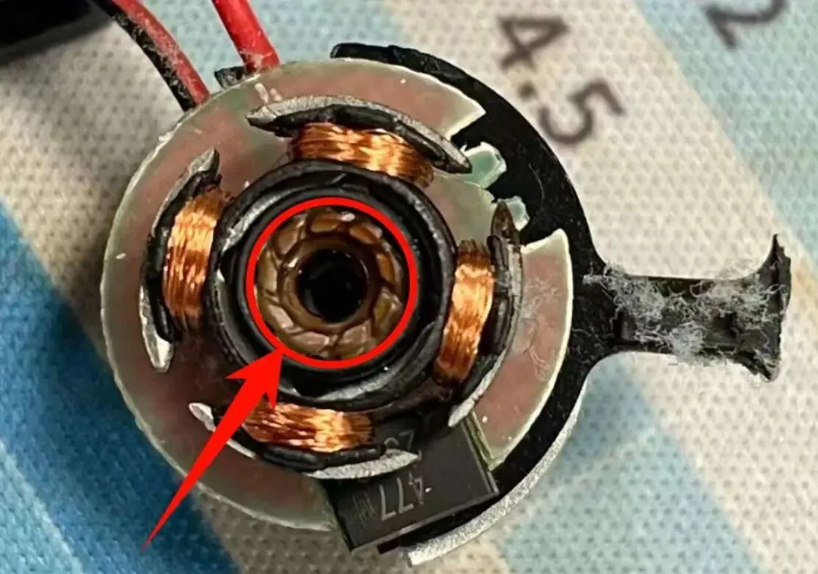
The prototype ran in the test environment for barely a week before the field team reported the fan was screaming. The grinding noise was unbearable. I had the faulty unit shipped back from the site. Well, look at that—the back of the fan blades and the outer frame were covered in oil. Experience tells us that a proper dual ball bearing fan uses solid grease; it shouldn’t have liquid oil, and definitely not leaking this much.
To figure out what was causing the noise, I took a flathead screwdriver and violently dismantled it. Popped the snap ring, pulled out the rotor, looked at the grooves in the stator, and that oil retention ring at the base… Look familiar? Yep, it was a hydraulic bearing masquerading as high-end hardware. The supplier played a little trick during sampling. We re-selected the part overnight. To prevent this rookie mistake from happening again in mass production, the first thing I did when the new supplier’s batch arrived was tear a brand-new one apart to check the internal structure.
Rethinking the Core Component: Why the “Bearing” Decides a Cooling Fan’s Fate
People often think a broken fan means a burnt motor or snapped blades. In reality, for equipment running in the field, the vast majority of fan failures come down to bearing wear.
As long as the rotor spins, physical friction exists. It doesn’t matter how beautifully you design the airflow for your industrial equipment cooling solutions; if the cooling fan bearings are trash, the shaft will run eccentric, or the lubrication will dry up. What follows is vibration, resonant noise, and eventually, a complete mechanical seize. The bearing doesn’t just dictate whether the fan spins for 30,000 or 80,000 hours—it dictates whether the fan will drive your clients crazy with noise when the equipment is running at full load.
A Breakdown of Common Cooling Fan Bearing Types
1. Sleeve Bearing: The Low-Cost Compromise
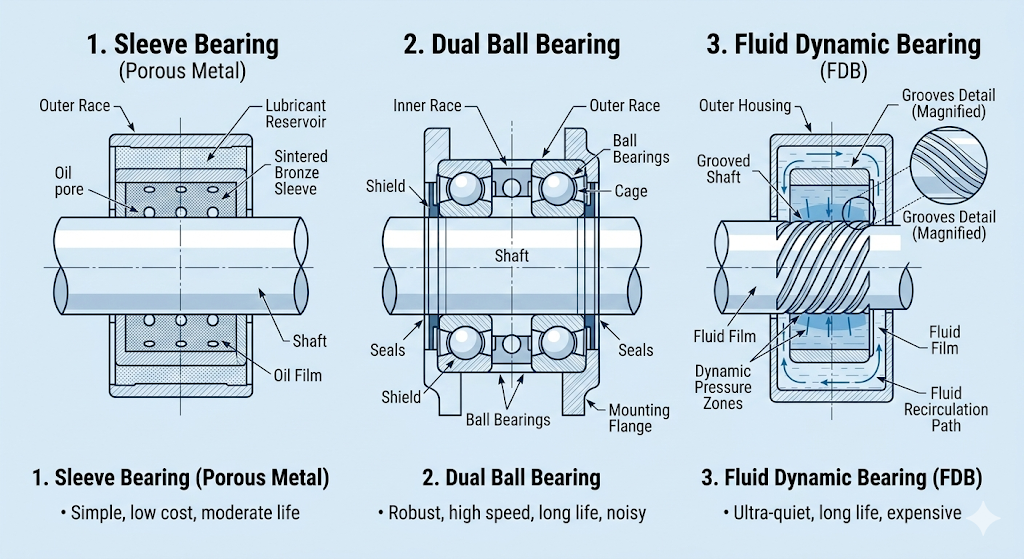
The structure here is as simple as it gets: a sintered copper sleeve holding the shaft, relying on the lubricating oil inside to form a film for operation.
- Characteristics: It’s genuinely quiet when you first power it on, and the cost is incredibly low. Purchasing departments love seeing these on a quote.
- The Fatal Flaw: The lubricant is liquid. Under the dual baking of motor heat and ambient temperature, it evaporates easily. Once the oil dries out, it’s just metal grinding on metal. You’re lucky to get 30,000 hours out of them. Also, never mount these flat or upside down. Gravity pulls the shaft off-center, making the oil leak faster and killing the fan sooner.
2. Dual Ball Bearing: The Industrial-Grade Choice for Longevity
Inside, two miniature ball bearings support the shaft. This is pure rolling friction.
- Characteristics: The lifespan is fiercely long—hitting 50,000 to 100,000 hours is standard. They handle high temperatures well. Whether you mount it sideways, upside down, or at an angle, the mechanical structure of the balls holds the shaft steady. It doesn’t care about mounting orientation.
- Drawbacks: They cost more. And because there is metal-on-metal rolling friction inside, if you listen closely, you’ll hear a faint “shhh” sound. If you’re weighing ball bearing vs sleeve bearing, the most practical difference is this: sleeve bearings start dead silent and then abruptly die; ball bearings have a slight white noise from day one, but they just refuse to break.
3. Fluid Dynamic / Magnetic Levitation Bearing (FDB/Maglev): The High-End Quiet Trend
A fluid dynamic bearing is essentially a heavily upgraded sleeve bearing. It uses special herringbone grooves to pump oil back inward as it spins, creating dynamic fluid pressure that drastically reduces the risk of leakage.
- Characteristics: It combines the early-stage silence of a sleeve bearing while dropping the oil leak risk to near zero.
- Applications: High-end equipment that is extremely sensitive to noise—think rack servers in a recording studio, premium medical instruments, or flagship home routers.
The COOling Fan : How to Choose When It Happens to You?
At the end of the day, fan selection in engineering is always a three-way tug-of-war between cost, lifespan, and noise. There’s no need to mindlessly over-spec, but you absolutely cannot pinch pennies on critical components. Find your scenario:
- Scenario A: 24/7 continuous operation, harsh cabinet environments Go straight for Dual Ball Bearings with your eyes closed. Rain or shine, they handle the heat and power through dust buildup. Nobody on an industrial factory floor cares if your fan makes a few extra decibels of bearing noise, as long as the machine doesn’t overheat and shut down.
- Scenario B: Consumer-grade products, noise-sensitive, medium lifespan requirements If you need quiet cooling fan recommendations for a new product thermal design, go with FDB (Fluid Dynamic Bearings). Clients won’t tolerate a buzzing device in the middle of the night, but the product’s life cycle is probably only 3 to 5 years anyway. The lifespan of an FDB covers that easily, and the noise control keeps people happy.
- Scenario C: Disposable low-cost toys or small short-lifespan devices The budget is dead locked, and the device will probably be thrown away in a year or so. Don’t hesitate—use Sleeve Bearings to control costs. They are cheap, work fine initially, and making it past the warranty period is a win.
The theoretical lifespan parameters a supplier swears by are usually tested in a 25°C, dust-free standard laboratory. Meanwhile, your enclosure might be shoved into a 45°C, sweltering, dust-filled factory floor. Before finalizing the specs, take samples from a few suppliers, throw them into a high-low temperature test chamber, and bake them continuously for 72 hours. Pull them out, crack them open, and look at the condition of the grease inside. That tells you more than reading a hundred-page datasheet ever will.