Vortex Coolers

Overview

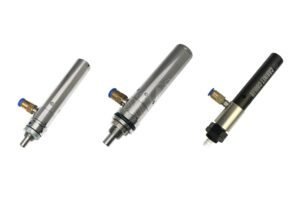
Leipole Vortex Coolers utilize compressed air within an oscillator to create intense cold air flow, aimed at the fast cooling of industrial machines and electronic components or small areas. No refrigerant, no moving parts, simple structure, low maintenance cost, and applicable to harsh environment and high reliability requirement scenario.

Key advantages

No refrigerant needed

Utilizes only compressed air, environmentally-friendly and offers zero risk of chemical pollution.

No moving parts

No motors or rotary moving parts that wear and tear, and more than 10 years of lifespan.

Rapid cooling

Quickly generate low temperature air flow (as low as -40°C) to achieve accurate cooling of core parts.

Super small and light

Compact size, convenient installation, with limited space in mind for industrial devices.

Low Running Cost

No periodic replacement of refrigerants and complex maintenance like refrigerator.

Models & specifications

Vortex Cooler for enclosures LEIPOLE

wdt_ID wdt_created_by wdt_created_at wdt_last_edited_by wdt_last_edited_at Model air inlet (psi/bar) vortex capacilty (scfm) vortex capacilty (l/min) refrigerating capacity (BTU/Hr) refrigerating capacity (WATTS)
53 Kiva 27/06/2025 12:00 AM Kiva 27/06/2025 12:00 AM LCL 106 100/6.9 6 170 420 123
54 Kiva 27/06/2025 12:00 AM Kiva 27/06/2025 12:00 AM LCL 108 100/6.9 8 230 560 164
55 Kiva 27/06/2025 12:00 AM Kiva 27/06/2025 12:00 AM LCL 111 100/6.9 11 310 770 225
56 Kiva 27/06/2025 12:00 AM Kiva 27/06/2025 12:00 AM LCL 115 100/6.9 15 450 1100 322
57 Kiva 27/06/2025 12:01 AM Kiva 27/06/2025 12:01 AM LCL 125 100/6.9 25 710 1750 513
58 Kiva 27/06/2025 12:01 AM Kiva 27/06/2025 12:01 AM LCL 130 100/6.9 30 850 2100 615
59 Kiva 27/06/2025 12:02 AM Kiva 27/06/2025 12:02 AM LCL 135 100/6.9 35 990 2450 718
60 Kiva 27/06/2025 12:02 AM Kiva 27/06/2025 12:02 AM LCL 140 100/6.9 40 1132 2800 820
61 Kiva 27/06/2025 12:02 AM Kiva 27/06/2025 12:02 AM LCL 145 100/6.9 45 1273 3150 923
62 Kiva 27/06/2025 12:03 AM Kiva 27/06/2025 12:03 AM LCL 150 100/6.9 50 1415 3500 1026

Applications

The following fields commonly use Leipole Vortex Coolers:

Industrial automation – Cooling of PLC controllers and servo motors to avoid overheating and shutdown.

Machining – Literally cool down CNC tools and spindles in real-time so you can prolong tool life.

Electronic communications – Safeguard 5G base stations and server chips from functioning stably at high temperatures

Automotive manufacturing – For welding robots and battery pack temp management

Basic knowledge

Vortex cooling principle

The principle of Vortex Coolers is based on the vortex tube effect, when the compressed air enters the vortex chamber, it will be separated into hot and cold air streams through high-speed rotation, and the temperature of the cold air flow can also be reduced to lower than the ambient temperature.

How do you pick the right model?

1. Determine the Heat Load

  • Measure the heat load inside the enclosure with BTU/hr or Watts.
  • Consider heat generated by electrical components (e.g., transformers, PLCs, motor drives).
  • Also consider for external heat, such as ambient temperature and solar radiation.

2. Identify the Required Cooling Capacity

  • Use the formula:Cooling Required (BTU/hr) = Heat Load (Watts) × 3.41
  • Compare this with the cooling capacity of vortex coolers available.

3. Consider the Enclosure Size and Material

  • Larger enclosures require higher cooling capacity.
  • Metal enclosures conduct heat differently than plastic ones.
  • Ensure the vortex cooler fits within the available space.

4. Determine the Air Supply and Consumption

  • Vortex coolers use compressed air (not electricity), so check:\ Available air pressure (typically 80-100 PSI required)\ Air consumption rate (measured in SCFM or L/min)

5. Consider Noise and Efficiency

  • Vortex coolers can be noisy; so all the set will come with a muffler.
  • For better solution, please also consider to purchase solenoid valve, air filter and thermostat.

6. Verify Installation Requirements

  • Mounting options: Side, top, or door-mounted.
  • Ensure proper airflow inside the enclosure for even cooling.

Frequently asked questions

Q1: What is the compressed air flow rate required for Vortex Coolers?

A: The air consumption of standard models is 5~20 SCFM (standard cubic feet per minute), depending on the cooling power.

Q2: Can it be used to cool high-temperature metal surfaces?

A: It can be used with high-temperature resistant air ducts (up to 300°C) to spray cold air directly at the heat source.

Q3: What is different between Vortex Cooling vs. Traditional Cooling

A:

Features Vortex Coolers Air Conditioner
Refrigerant NO need Requires Freon or other refrigerants
Moving Parts NONE Compressor, fan, etc.
Maintenance Cost Very low Regular maintenance
Applicable Scenarios Local cooling, small space Large space overall cooling

Product inquiry

Selection & support

Selecting LEIPOLE vortex coolers

Check the heat load and the compressed-air supply before choosing a model.

How does a vortex cooler work?

Compressed air enters a vortex chamber and spins at high speed, which separates it into a hot and a cold stream. The cold stream, as low as -40 °C, is blown into the enclosure and the hot air is exhausted, so there is no refrigerant and there are no moving parts.

Read how vortex coolers work

Does a vortex cooler need electricity?

No. A vortex cooler runs on compressed air, typically at 80–100 PSI, and standard models use about 5–20 SCFM depending on cooling power. A solenoid valve and a thermostat can be added so air flows only when cooling is needed.

See cooling thermostats

How do I size a vortex cooler for an enclosure?

Work out the heat load in watts, convert it with cooling required (BTU/h) = heat load (W) × 3.41, and compare the result with the LCL 106 to LCL 150 models. Then check that the compressed-air supply delivers the pressure and flow the model needs.

Confirm the model

When should I choose a vortex cooler instead of an enclosure air conditioner?

Vortex coolers suit local cooling of small enclosures or hot spots where compressed air is available and space is tight. For overall cooling of larger cabinets, compare enclosure air conditioners.

Compare air conditioners