Frequently asked questions
Q1: Can I mix different UN Series blocks on the same DIN rail?
Yes. All UN Series blocks share identical rail-mount dimensions, allowing you to combine UN2.5, UN4, UN6, and UN10 models on the same 35 mm DIN rail for a compact multi-pole assembly.
Q2: How do I label each circuit on a barrier block?
Use compatible marker strips or printed sachets inserted into the integrated marking slot above each pole. This ensures clear, legible identification for maintenance.
Q3: Are these barrier blocks suitable for both AC and DC applications?
Yes. UN Series blocks are rated 250 to 660 V, making them appropriate for AC control circuits and DC distribution wiring alike.
Q4: What torque should I use when tightening the screws?
Tighten screws to the specified torque values: 0.6–0.8 Nm for UN2.5 and UN4, and 1.2–1.4 Nm for UN6 and UN10. Proper torque ensures reliable contact without damaging conductors.
Q5: Can I add end stops to prevent block movement?
Yes. End-stop clamps lock into the rail beside the last block to prevent accidental sliding. They are recommended for assemblies with frequent vibration.
Q6: How do I ensure proper clearance between poles?
LEIPOLE barrier blocks have molded barriers with adequate clearance distances. For higher-voltage circuits, use UN6 or UN10 which have larger creepage and clearance ratings.
Why use barrier terminal blocks for industrial wiring?
They provide secure conductor separation with insulated barriers, preventing short circuits in high‑density wiring environments.
What makes a 600V barrier terminal block ideal for high‑voltage applications?
Its reinforced insulation and high‑grade contact materials ensure safe operation under elevated voltage and current loads.
When should I choose a PCB‑mount barrier terminal block?
For integrating high‑voltage or high‑current terminations directly onto circuit boards while maintaining isolation between conductors.
Why are barrier terminal blocks suitable for marine environments?
Their corrosion‑resistant materials and rugged insulation withstand moisture, vibration, and salt‑spray exposure.
What is the purpose of a cover on a barrier terminal block?
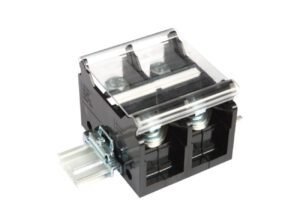
It provides additional protection against accidental contact and debris ingress, enhancing electrical safety in open‑panel installations.