Frequently asked questions
Q1: Can I insert stranded wires directly into JST blocks?
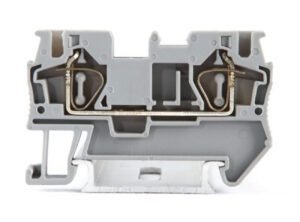
Yes. JST terminals securely hold both solid and stranded wires. For stranded wires, using ferrules can improve insertion consistency.
Q2: How do I release a wire from a JST spring terminal?
Use a flat-blade screwdriver or the integrated release button to depress the spring element, then pull the conductor out easily.
Q3: Are JST spring terminals suitable for high-vibration environments?
Absolutely. The spring mechanism consistently maintains clamping force even under continuous vibration, making them ideal for mobile machinery and rail applications.
Q4: What safety standards do JST blocks comply with?
JST Series uses UL94 V-0 flame-retardant PA66 housing and meets IEC/EN 60947-7-1 requirements for terminal blocks. They also conform to RoHS and REACH directives.
Q5: Can I stack or bridge multiple JST blocks?
Yes. JST blocks feature standardized lateral and vertical bridge slots, allowing quick installation of jumper bars or busbars for parallel or multi-pole circuit distribution.
Q6: What ambient temperatures are supported?
JST blocks operate safely from –20 °C to +70 °C. Ensure panels remain within this range and provide adequate ventilation for continuous loads.
Why use spring‑loaded terminal blocks in control wiring?
They ensure stable, vibration‑proof connections that maintain contact pressure without re‑tightening, ideal for long‑term panel reliability.
How do push‑in spring terminal blocks speed up installation?
Simply insert the conductor without tools; the spring mechanism locks it securely, reducing wiring time by up to 50%.
What’s the benefit of a DIN‑rail spring terminal block with a lever?
The lever allows easy conductor release without tools, making frequent wiring changes faster and safer.
When should I choose a 41A spring clamp terminal block?
For compact power distribution where high‑current capability and maintenance‑free performance are required.
Why choose a compact multi‑level spring terminal block?
It maximizes wiring density in control cabinets while maintaining clear circuit separation in a small footprint.