Din rails

Overview

Standardized Din Rail Terminal Solutions with Enhanced Reliability

  • Adopt the latest 35mm standard Din Rails specifications to ensure perfect compatibility with global accessories
  • Din Rail Terminal Blocks adopt a quick snap-on design for quick tool-free installation
  • Din Rail Mount Terminal Block is equipped with an anti-loosening structure to effectively cope with high vibration environments
  • Din Rail Connector Blocks support flexible modular expansion to meet different system requirements
  • Professional-grade Electrical Railing design with a load-bearing capacity of more than 50kg per meter
  • Din Rail Dimensions meet international standards and provide a variety of length options (1m/2m/3m)
  • Made of high-quality galvanized steel, with excellent corrosion resistance and conductivity
  • DIN rail special treatment process ensures a service life of more than 10 years
  • Innovative rail groove design, suitable for various standard terminals and accessories
  • Integrated stamping molding provides higher structural strength and stability

Key advantages

  • Standard Compliance

    : Manufactured according to

    IEC/EN 60715

    standards, ensuring compatibility with global industrial components.

  • Material Excellence

    : Constructed from high-quality galvanized steel, offering superior corrosion resistance and mechanical strength.

  • Versatile Mounting

    : Available in both

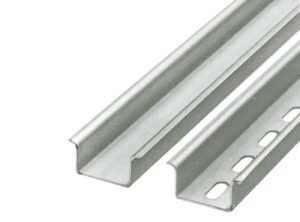
    perforated

    and

    unperforated

    versions, catering to diverse installation requirements.

  • Dimensional Precision

    : Strict adherence to dimensional tolerances guarantees seamless integration with

    DIN rail mount

    devices.

  • Enhanced Load Capacity

    : Robust design supports heavier components, reducing the risk of deformation under load.

Models & specifications

LEIPOLE DIN Rail NS 35 15

Screw terminal block Pluggable terminal block Spring type terminal block Barrier terminal block

wdt_ID wdt_created_by wdt_created_at wdt_last_edited_by wdt_last_edited_at model Wide(W)      mm  Tall(H)     mm  Thickness(T)mm  Length(L)    M Custom pass  (ø)mm  Standard pass      (ø)mm  
1 Kiva 07/07/2025 04:31 AM Kiva 07/07/2025 04:31 AM NS35/7.5 35 75,00 1,00 1/2 5.2×15 6.2×15
2 Kiva 07/07/2025 04:31 AM Kiva 07/07/2025 04:31 AM NS35/6.5 35 65,00 1,00 1/3 5.2×15 6.2×15
3 Kiva 07/07/2025 04:31 AM Kiva 07/07/2025 04:31 AM NS35/15 35 15,00 15,00 1/4 5.2×15 6.2×15
4 Kiva 07/07/2025 04:31 AM Kiva 07/07/2025 04:31 AM NS15/5.5 15 55,00 1,00 1/5 - 4.2×12.2
5 Kiva 07/07/2025 04:31 AM Kiva 07/07/2025 04:31 AM NS32/15 32 15,00 12,00 1/6 - 6.2×15
6 Kiva 07/07/2025 04:31 AM Kiva 07/07/2025 04:31 AM NS35/7.5  Aluminum  35 75,00 1,00 1/7 - 4.8×25
7 Kiva 07/07/2025 04:31 AM Kiva 07/07/2025 04:31 AM NS35/7.5 Aluminum  35 75,00 15,00 1/8 - 5.2×15
8 Kiva 07/07/2025 04:31 AM Kiva 07/07/2025 04:31 AM NS32/15 Aluminum  32 15,00 15,00 1/9 - 6.2×15
9 Kiva 07/07/2025 04:31 AM Kiva 07/07/2025 04:31 AM NS25/10 Aluminum  25 10,00 11,00 1/10 - 4.8×25
model Wide(W)      mm  Tall(H)     mm  Thickness(T)mm  Length(L)    M Custom pass  (ø)mm  Standard pass      (ø)mm  

DIN rail sizes

Width × height and slot sizes by profile, in mm, from the DIN rail model table. Height is the second figure of the profile name: NS35/7.5 is 7.5 mm high and NS35/15 is 15 mm. Steel rails are galvanized. Rails come perforated or unperforated, in 1 m, 2 m and 3 m lengths.
ProfileWidth × height (mm)Steel slot (mm)Aluminium slot (mm)
NS35/6.535×6.56.2×15; custom 5.2×15—
NS35/7.535×7.56.2×15; custom 5.2×154.8×25 or 5.2×15
NS35/1535×156.2×15; custom 5.2×15—
NS32/1532×156.2×156.2×15
NS25/1025×10—4.8×25
NS15/5.515×5.54.2×12.2—

Applications

  • Industrial Automation

    : Mounting PLCs, contactors, and relays within control panels.

  • Power Distribution

    : Organizing circuit breakers and terminal blocks in distribution boards.

  • Building Management Systems

    : Integrating sensors and controllers for HVAC and lighting systems.

  • Renewable Energy

    : Securing inverters and monitoring devices in solar and wind energy installations.

Basic knowledge

Understanding DIN Rail Types

  • Top Hat Rails (NS 35)

    : Characterized by their symmetrical profile, these rails are widely used due to their versatility and ease of installation.

  • Miniature Top Hat Rails (NS 15)

    : Designed for applications where space is limited, maintaining compatibility with smaller devices.

  • G-Type Rails (NS 32)

    : Their asymmetrical design provides additional support, making them suitable for heavier equipment.

  • Aluminum Rails (NSL 35)

    : Lightweight and corrosion-resistant, ideal for environments where weight and corrosion are concerns.

Perforated vs. Unperforated DIN Rails

  • Perforated

    : Feature pre-drilled holes for easy mounting, reducing installation time.

  • Unperforated

    : Offer flexibility in hole placement, allowing customization based on specific requirements.

  • Precision Matter: DIN Rail Dimensions & Tolerances

    • Standard DIN rail 35 mm (EN 60715 TS 35) must be cut to exact lengths (e.g., DIN rail 1 m) with ±0.2 mm tolerance. Too tight and equipment jams; too loose and modules wobble under vibration.

    • Beware “off-brand” rails that deviate in depth or flange width—your DIN rail dimension check gauge must include both the top hat height and slot width.

  • Mounting Variations: TS 35 vs. TS 32 & NS 15

    • TS 35 DIN rail is the industry workhorse; TS 32 DIN rail sees frequent use in compact sub-cabinets.

    • NS 15 perf 2000 mm rails integrate pre-punched mounting holes every 50 mm, enabling rapid panel layouts—ideal for large data centers.

  • Rack-Mount & Hybrid Installations

    • A rack mount DIN rail clip system lets you attach TS 35 rails directly to 19″ racks. Use spring-steel clips to maintain rail flatness across horizontal spans.

    • In telecom or lab racks, staggering DIN rail mount positions prevents single-point failure and eases airflow.

  • Material & Finish Secrets

    • Zinc-plated steel is standard, but in high-humidity or corrosive venues, opt for stainless-steel or T35-C1 (electrogalvanized + passivation).

    • Self-extinguishing polymer rails exist—use where arc-flash risk or chemical vapors demand non-conductive mounting.

  • “DIN Rail Near Me” Sourcing Strategy

    • Local fasteners suppliers often stock cut-to-length rails (e.g., 500 mm or 1 m in-stock), saving lead time over custom orders.

    • Use online “DIN rail near me” searches to find certified local stockists—ideal when project deadlines accelerate.

  • Installation & Vibration Mitigation

    • Always install rails with anti-vibration end stops; unbraced rail ends can flex under harmonic loads, leading to terminal loosening.

    • Use nylon spacers on rack mount DIN rail to dampen chassis-borne vibration in mobile or vehicle-mounted panels.

  • Future-Proofing Your Panel

    • Leave a 10 % over-hang at each rail end (“sacrificial length”) for late additions—cutting rails mid-project compromises alignment.

    • Mark rail dimensions on panel backer plates in CAD drawings to prevent mis-ordering during revisions.

Frequently asked questions

Q1: What is the difference between NS 35/7.5 and NS 35/15 DIN rails?


A1

: The primary difference lies in their height; NS 35/7.5 has a height of 7.5mm, while NS 35/15 is 15mm high. The taller NS 35/15 provides increased rigidity, making it suitable for heavier components.

Q2: Are LEIPOLE DIN rails compatible with components from other manufacturers?


A2

: Yes, LEIPOLE DIN rails conform to international standards, ensuring compatibility with components from various manufacturers.

Q3: Can I cut DIN rails to a specific length?


A3

: Absolutely. DIN rails can be cut to the desired length using appropriate cutting tools, allowing for customized installations.

Q4: Do you offer accessories for DIN rail installations?


A4

: Yes, LEIPOLE provides a range of accessories, including end clamps, spacers, and mounting brackets, to facilitate complete DIN rail installations.

How do you install a rack mount DIN rail in a 19″ cabinet?

To install a rack mount DIN rail, clip or screw TS 35 rails onto 19″ rack ears using spring-steel mounting brackets. Ensure the rail is level, then snap your modules onto the rail. This method secures the rail and maintains panel alignment.

What are the exact dimensions of a standard DIN rail 35 mm (TS 35)?

A DIN rail 35 mm (EN 60715 TS 35) has a top-hat profile 35 mm wide, 7.5 mm depth per flange, and a total height of 15 mm. Flange thickness and slot width tolerances must be ±0.2 mm to guarantee module compatibility.

When should you choose a TS 32 DIN rail instead of TS 35?

Use a TS 32 DIN rail for compact enclosures or sub-panels where space is tight. Its narrower 32 mm width saves room but still supports standard DIN-rail modules. TS 35 remains the go-to for larger, heavier components.

What is the benefit of NS 15 perf 2000 mm rails in large-scale installations?

NS 15 perf 2000 mm rails come pre-punched every 50 mm for mounting flexibility. Their 2 m length covers long backplates without splicing—ideal for data centers or industrial switchrooms needing consistent rail runs.

How can I find “DIN rail near me” for quick project turnarounds?

Search local electrical distributors or industrial fastener suppliers online for “DIN rail near me.” Many stock cut-to-length rails (e.g., 500 mm, 1 m DIN rail) in metric sizes, reducing lead times when deadlines are tight.

Product inquiry

Selection & support

Selecting LEIPOLE DIN rails

Match the rail profile, material and length to the devices mounted in your panel.

What is a DIN rail?

A DIN rail is a standardised metal rail, 35 mm wide in its common top-hat form, that terminal blocks, circuit breakers, relays and PLCs clip onto inside control panels. LEIPOLE rails are made to IEC/EN 60715 in galvanized steel or aluminium.

See terminal blocks

What does DIN stand for in DIN rail?

DIN stands for Deutsches Institut für Normung, the German standards body that first standardised the rail. The dimensions are now set internationally by IEC/EN 60715, so rails and devices from different makers fit together.

Check technical documents

What are the standard DIN rail sizes and dimensions?

LEIPOLE supplies the top-hat NS35/7.5 (35 mm wide, 7.5 mm deep) and NS35/15 (35 × 15 mm), the asymmetric G-type NS32/15 and the miniature NS15/5.5, perforated or unperforated, in 1 m, 2 m and 3 m lengths. NS35/7.5, NS32/15 and NS25/10 also come in aluminium. The model table lists width, height, thickness and hole sizes.

Check technical documents

What is the difference between 7.5 mm and 15 mm deep DIN rails?

Both are 35 mm top-hat rails, so the same devices clip onto them. The 15 mm deep rail is stiffer and suits heavier devices, longer unsupported spans or more space behind the rail; the 7.5 mm rail is the usual choice for terminal blocks and breakers.

Confirm the profile

Should I choose a steel or aluminium DIN rail?

Galvanized steel is the standard choice for strength and corrosion resistance, with a load capacity of more than 50 kg per metre. Aluminium rails are lighter and corrosion-resistant, for installations where weight matters.

Request a quotation

How do I use DIN rail terminal blocks?

Clip each block onto the 35 mm rail, strip the conductor to the length given in the data sheet and clamp it with the screw or spring connection. Close the open side of the last block with an end plate, lock the row with end stops and add markers.

See spring terminal blocks

How do I cut and mount a DIN rail in an enclosure?

Cut the rail to length with a hacksaw or rail cutter and deburr it, then screw it to the mounting plate through the slots of a perforated rail or holes drilled in an unperforated one. Fit end stops so devices cannot slide under vibration.

Plan the cable ducting

Where can I buy DIN rails in Singapore, and what do they cost?

Ask the Singapore team for a quotation with the profile, material, length (1 m, 2 m or 3 m) and quantity; prices depend on these and are quoted on request. The team can also confirm stock and delivery to your site.

Request a quotation

Are stainless-steel DIN rails available?

The standard rails are galvanized steel and aluminium. For high-humidity or corrosive sites a stainless-steel rail can be the better choice; send the profile and length so the team can confirm what can be supplied.

Ask about stainless steel