- Enclosure thermal management. Reliable connections. Practical solutions.
- Customer Portal ↗
Cable clamps
ENGINEERING SUPPORT
Find the right fit.
Talk to our team about product selection and your application.
Contact technical supportOverview
Key advantages
HEAVY DUTY BUILDING — constructed of top-grade, rustproof materials ensures for life time compatibility
Easy Installation — Designed for easy and secure mounting
Wide Application – Comes in different sizes to suit cable dimensions
Improved Safety – Offers stable electrical connection at high load conditions
Models & specifications
| wdt_ID | wdt_created_by | wdt_created_at | wdt_last_edited_by | wdt_last_edited_at | Model | Order number | Cable diameter Φ (mm) | B mm | H mm |
|---|---|---|---|---|---|---|---|---|---|
| 1 | Kiva | 08/07/2025 07:29 AM | Kiva | 08/07/2025 07:29 AM | UB6-12 | 5011.001 | 6–12 | 21 | 23 |
| 2 | Kiva | 08/07/2025 07:29 AM | Kiva | 08/07/2025 07:29 AM | UB12-18 | 5011.002 | 12–18 | 24 | 75 |
| 3 | Kiva | 08/07/2025 07:29 AM | Kiva | 08/07/2025 07:29 AM | UB18-22 | 5011.003 | 18–22 | 27 | 70 |
| 4 | Kiva | 08/07/2025 07:29 AM | Kiva | 08/07/2025 07:29 AM | UB22-30 | 5011.004 | 22–30 | 39 | 85 |
| 5 | Kiva | 08/07/2025 07:29 AM | Kiva | 08/07/2025 07:29 AM | UB30-38 | 5011.005 | 30–38 | 45 | 90 |
| 6 | Kiva | 08/07/2025 07:29 AM | Kiva | 08/07/2025 07:29 AM | UB38-42 | 5011.006 | 38–42 | 47 | 95 |
| 7 | Kiva | 08/07/2025 07:29 AM | Kiva | 08/07/2025 07:29 AM | UB42-50 | 5011.007 | 42–50 | 57 | 120 |
| 8 | Kiva | 08/07/2025 07:29 AM | Kiva | 08/07/2025 07:29 AM | UB50-64 | 5011.008 | 50–64 | 70 | 130 |
| 9 | Kiva | 08/07/2025 07:29 AM | Kiva | 08/07/2025 07:29 AM | UB12.2 | 5011.009 | 6–12 | 16 | 75 |
| 10 | Kiva | 08/07/2025 07:29 AM | Kiva | 08/07/2025 07:29 AM | UB14.2 | 5011.01 | 12–14 | 18 | 77 |
| Model | Order number | Cable diameter Φ (mm) | B mm | H mm |
Applications
Our cable clamps are used across all sectors to provide a secure electrical connection:
Power Distribution Systems – Switchgear, substations, and distribution boards secure connections
Electrical Enclosures – Connection in control panels and switch boards
Industrial Machinery — Supporting heavy-load operations in manufacturing plants
Commercial infrastructure – Improved electrical performance in demanding installations
Basic knowledge
What are Cable Clamps?
Cable clamps are critical elements in the assembly that are used to couple cable firmly together, allowing for optimal electric conduction with little energy loss. These SMD coils are manufactured with precision techniques and comply to international standards to optimize your high current applications.
Key Specifications:
● Material: Antirust copper alloy or aluminum alloy
● Current Rating: Multiple models to accommodate a range of high-load applications
● Design: Built for security and optimal conductivity
● Standards: CE and RoHS compliant
1. Beyond Basic Securing: Strain Relief & Bend-Radius Control
Strain relief: A properly chosen clamp doesn’t just hold a cable; it prevents conductors from pulling on terminations under tension. In high-vibration environments (e.g., machine tools), a misplaced clamp can lead to intermittent faults far from the panel.
Bend-radius maintenance: Multi-cable clamps with built-in radius control keep each cable bend above its minimum spec, reducing conductor fatigue and insulation cracking over time.
2. Material & Environmental Secrets
Nylon vs. Stainless Steel: Nylon clamps (UL94 V0 rated) are lightweight and resist many chemicals, but become brittle below –10 °C. Stainless-steel clamps, often overlooked, excel in sub-zero or corrosive (marine, chemical) atmospheres—no UV or solvent-breakdown.
Elastomer inserts: Rubber-lined or cushioned clamps dampen vibration and protect insulation. In precision instrumentation panels, this can reduce microphonic noise on sensitive signal lines by up to 80%.
3. Installation & Layout Best Practices
Clamping pitch: Industry rule of thumb is one clamp every 30 cm for static runs, but every 10–15 cm for mobile or vibrating assemblies. Too few, and cables sag; too many, and cable harnesses become rigid, transferring vibration to terminations.
Torque & compression: Over-tightening metal clamps can deform cable jackets. Use a torque-limited screwdriver or hand-feel gauge. Aim for firm grip without crushing—the sweet spot extends clamp life by 3×.
4. Thermal Cycling & Expansion Management
In environments cycling from –40 °C to +85 °C, clamps must accommodate cable expansion. Rigid clamp spacing without expansion gaps causes insulation stress cracks. Plan “expansion joints” every 1 m of harness.
5. EMI Control & Grounding Integration
Shielded-cable clamps with integrated grounding tabs can bond cable shields directly to chassis ground, eliminating separate grounding straps. This is a game-changer in telecom racks where EMI regs are strict.
Avoid plastic clamps on screened power cables—use metal-backed clamps bonded with star washers for low-impedance earthing.
6. Fire-Safety & Outgassing Considerations
In critical infrastructure (data centers, hospitals), halogen-free, low-smoke-zero-halogen (LSZH) clamps prevent toxic fume release during fires. Many generic clamps off-gas corrosive acids, damaging sensitive electronics.
7. Modular & Retrofit Solutions
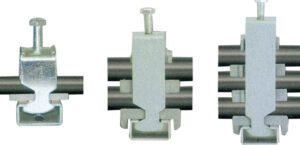
DIN-rail cable clamp modules let you preassemble harnesses on small TS 35 rails, then snap the entire block into new panels for rapid rebuilds. This cuts wiring time by 50% in repeat-build scenarios.
Stackable multi-tier clamps maximize vertical space in shallow enclosures, keeping power, signal, and data lines separated but bundled.
Frequently asked questions
Q1: What is the maximum current rating of your Busbar Clamps?
A: Our clamps are available in various models designed to handle different high-load requirements. Please contact our technical team for specific ratings.
Q2: Are these clamps compatible with both copper and aluminum busbars?
A: Yes, our clamps are designed for excellent compatibility with both copper and aluminum busbars.
Q3: Do you offer custom sizes and configurations?
A: Absolutely. We provide OEM/ODM services to customize clamps according to your project specifications.
What are heavy‑duty cable clamps used for in industrial applications?
Heavy‑duty cable clamps secure and route large‑diameter cables in control panels, machinery, and outdoor installations, preventing cable movement and strain damage under vibration or load.
How do stainless steel cable clamps perform in harsh environments?
Stainless steel cable clamps provide exceptional corrosion resistance, making them ideal for marine, offshore, chemical, and outdoor applications exposed to salt, moisture, or industrial contaminants.
What is the advantage of using adjustable cable clamps for routing?
Adjustable cable clamps allow flexible positioning and re‑tightening of cables without full removal, enabling quick maintenance and cable re‑routing in modular panel layouts.
Why choose cushioned cable clamps for sensitive wiring?
Cushioned cable clamps feature rubber or elastomer inserts that absorb vibration and protect cable insulation, especially for instrumentation, fiber optic, or high‑flex cables.
Can cable clamps be mounted on DIN rail for modular installations?
Yes. DIN rail‑mounted cable clamps snap directly onto TS 35 or TS 32 rails, allowing tool‑free installation and easy relocation during panel modifications.
Product inquiry
Related products
Related products
Selection & support
Selecting LEIPOLE cable clamps
Match the clamp to the cable outer diameter and the way the cable run moves.
What cable clamp size do I need?
Choose the clamp whose cable diameter range covers the outer diameter of your cable: the UB series runs from UB6-12 for 6–12 mm cables to UB50-64 for 50–64 mm cables. Each model has its own order number in the table.
Confirm the size →How far apart should cable clamps be?
A common rule is one clamp every 30 cm on static runs and every 10–15 cm on moving or vibrating assemblies. Too few let cables sag; too many make the harness rigid and pass vibration to the terminations.
See cable ducting →