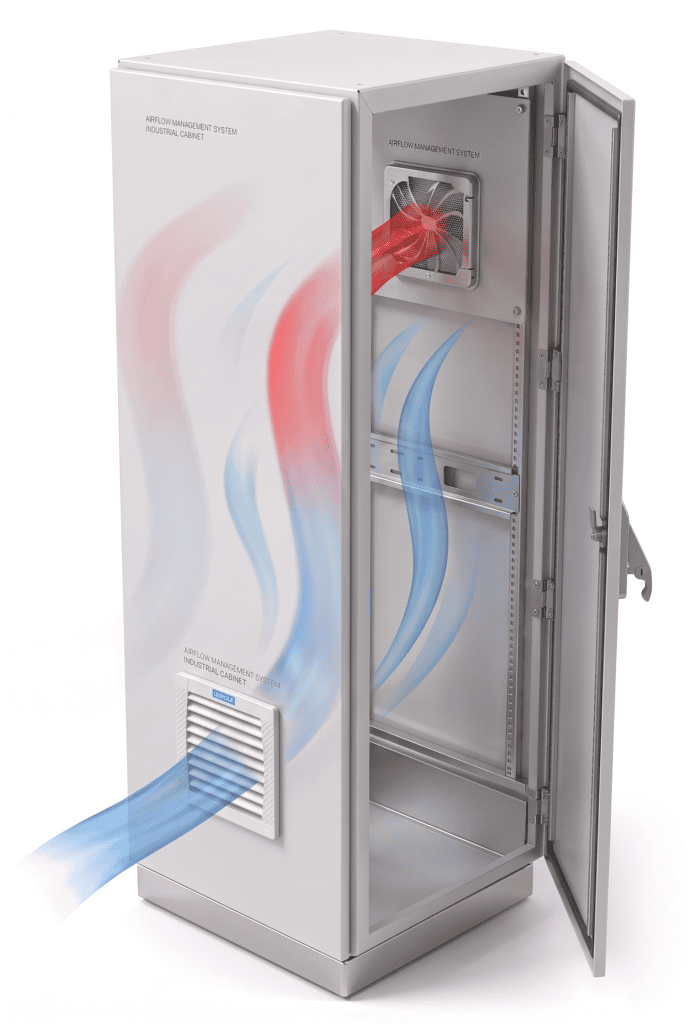
As industrial automation systems become more sophisticated, the thermal loads inside control cabinets continue to rise. Variable frequency drives (VFDs), PLCs, and power supplies generate significant heat, which can lead to catastrophic component failure if not managed properly. While traditional compressor-based air conditioners and filter fans are common, they aren’t always suitable for harsh, dirty, or high-temperature environments.
For these demanding applications, engineers often turn to a highly reliable, maintenance-free alternative: the vortex cooler.
This guide breaks down exactly what a vortex cooler is, the physics behind how it works, and how to specify the right compressed air cooling system for your electrical enclosures.
A vortex cooler is a compact, mechanical device that utilizes a standard supply of compressed air to generate a stream of sub-zero air for electrical enclosure cooling.
Unlike conventional cabinet air conditioners, a vortex cooler contains absolutely no moving parts, no refrigerants, and no compressor. Instead, it relies on a fluid dynamics phenomenon known as the Ranque-Hilsch vortex tube effect to separate standard compressed air into two distinct streams: one hot and one cold. The cold air is directed into the control cabinet to flush out heat and maintain safe operating temperatures for sensitive electronics.
How Does a Vortex Cooler Work? (The Vortex Tube Principle)
To understand the vortex cooler working principle, you have to look inside its core component: the vortex tube.
Here is the step-by-step process of how compressed air is converted into a reliable cabinet cooling solution:
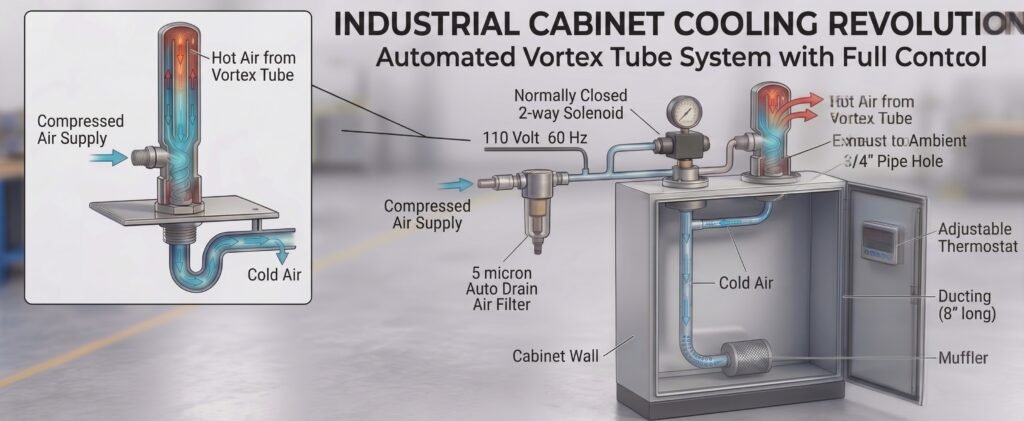
Air Injection: Standard factory compressed air (typically 80 to 100 PSIG) is injected tangentially into the vortex generator chamber of the cooler.
The Primary Vortex (Hot): This tangential injection forces the air to spin at extremely high speeds (up to 1,000,000 RPM) as it travels down the length of the main hot tube. As this outer ring of air spins, it absorbs heat due to kinetic energy transfer and friction. This hot air reaches the end of the tube, where a small valve allows a portion of it to exhaust into the ambient atmosphere.
The Secondary Vortex (Cold): The remaining air is forced to turn 180 degrees and travel back up the center of the tube, inside the outer spinning ring. As this inner column of air travels back, it loses momentum and transfers its heat to the outer ring.
Cold Air Delivery: By the time this inner column of air exits the opposite end of the vortex tube, its temperature has dropped drastically. This cold air is then piped directly into the electrical cabinet.
Positive Pressure & Exhaust: The continuous flow of cold air creates a slight positive pressure inside the cabinet. A built-in relief valve on the vortex cooler allows the hot, internal cabinet air to exhaust out, preventing ambient dust and moisture from entering.
Recommended Front-End Setup: Air Filter, Solenoid Valve & Thermostat
A vortex cooler only conditions the air it’s given — it cannot remove contaminants or moisture from the incoming compressed air supply. For this reason, Leipole recommends installing three components upstream of every vortex cooler, on the compressed air line itself:
- Compressed air filter: Removes particulates, oil carryover, and — critically — moisture from the air line before it reaches the vortex tube. Any water vapor present in the incoming compressed air will be carried straight into the enclosure and can condense on cold internal surfaces and electronic components, defeating the purpose of a dry, positive-pressure cabinet.
- Solenoid valve: An electrically actuated on/off valve at the air inlet that gates the compressed air supply to the cooler.
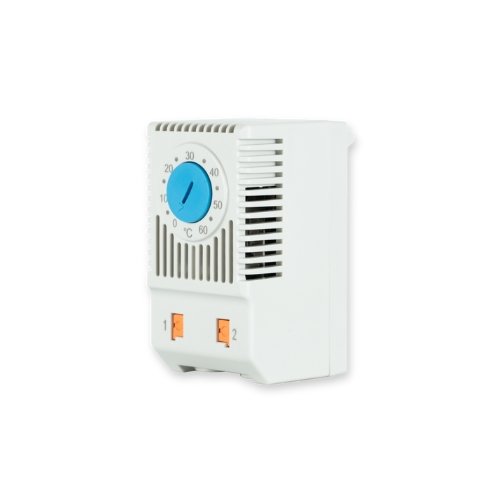
- Thermostat: Mounted inside the cabinet to monitor internal temperature, it signals the solenoid valve to open once the enclosure reaches the setpoint and to close again once the temperature drops back into a safe range.
Installed together, this filter–solenoid–thermostat front end does two jobs at once: it keeps moisture out of the air stream to prevent internal condensation, and it turns the vortex cooler into a demand-controlled system rather than one that runs continuously — which meaningfully reduces compressed air consumption, since compressed air is one of the more expensive utilities on a typical plant floor.
Advantages of Using Vortex Coolers
Why do engineers specify a compressed air cooling system over traditional AC units? The structural simplicity of the vortex cooler offers several distinct operational advantages:
- High Reliability: With zero moving parts to wear out, vortex coolers are virtually immune to mechanical failure.
- Maintenance-Free: There are no filters to clean on the cooler itself (only the upstream compressed air line filter), no condenser coils to unclog, and no refrigerant to recharge.
- Intrinsically Safe for Harsh Environments: Because they run purely on compressed air and require no electrical connections at the cooler itself, they are ideal for hazardous, explosive, or highly contaminated zones (e.g., foundries, steel mills, and chemical plants).
- Compact Footprint: Vortex coolers take up minimal space on a cabinet wall or roof, making them perfect for confined industrial automation layouts.
- Maintains Enclosure Integrity: They preserve NEMA 4, NEMA 4X, and IP66 ratings, keeping out water, dust, and corrosive elements.
Industrial Applications
Vortex coolers are deployed across a wide range of heavy-industry sectors where conventional cooling fails. Common applications include:
- PLC Cabinets in Foundries: Where ambient temperatures exceed the operating limits of standard refrigerant ACs.
- CNC Machining Centers: Where airborne coolant mist and metal shavings quickly clog standard filter fans.
- Food & Beverage Processing: Where frequent high-pressure washdowns require strict NEMA 4X/IP66 enclosure seals and no risk of refrigerant leaks.
- Remote Control Panels: Where sending an HVAC technician for regular maintenance is logistically difficult.
Comparison: Vortex Cooler vs. Other Cooling Methods
| Cooling Method | Moving Parts? | Maintenance Level | Best For… | Limitations |
| Vortex Cooler | None | Extremely Low | Harsh, dirty, high-temp environments | Requires a constant supply of clean, dry compressed air |
| Compressor AC | Yes (Fans, Compressor) | High | Large thermal loads in standard factory floors | Prone to failure in highly contaminated air; requires filter changes |
| Air-to-Air Heat Exchanger | Yes (Fans) | Medium | Environments where ambient temp is strictly lower than cabinet temp | Cannot cool below ambient temperature |
| Filter Fans | Yes (Fans) | High (filter replacement) | Clean environments with low thermal loads | Pulls ambient factory air (and dust) directly into the cabinet |
Selection Guide for Engineers
Specifying a vortex cooler requires evaluating a few specific engineering parameters to ensure adequate heat dissipation:
- Calculate the Total Heat Load: Determine the heat generated by the internal components (VFDs, transformers, PLCs) in Watts or BTU/hr, plus any solar heat gain if the cabinet is outdoors.
- Determine Available Air Pressure: Vortex coolers are rated at specific pressures (usually 100 PSIG). Lower line pressures will significantly reduce the cooling capacity (BTU/hr output).
- Select the Right NEMA/IP Rating: Ensure the cooler matches or exceeds the rating of your cabinet. Use stainless steel NEMA 4X models for corrosive or washdown environments.
- Size the Front-End Filter, Solenoid Valve, and Thermostat: Don’t treat these as optional accessories — pair every vortex cooler with an upstream air filter, a solenoid valve, and a cabinet thermostat (see above) to control moisture and minimize compressed air usage.
Frequently Asked Questions (FAQ)
Does a vortex cooler need electricity to operate?
No. The core mechanism of a vortex cooler requires no electricity. It relies entirely on the kinetic energy of compressed air. However, the recommended solenoid valve and thermostat used to regulate air consumption do require power.
How cold does a vortex tube get?
Depending on the inlet pressure and the cold fraction setting, a vortex cooler typically delivers a temperature drop of around 50°F (28°C) below the incoming compressed air temperature at 100 PSIG — the standard spec for packaged cabinet cooling systems. Bare vortex tubes tuned for point cooling at very low cold fractions can achieve much larger drops (120°F+), but that comes at the cost of significantly reduced cold air flow, which makes them unsuitable for continuous enclosure cooling.
Do vortex coolers cause condensation inside the cabinet?
Not when specified correctly. Because vortex coolers create a positive pressure environment using dry compressed air, they generally prevent ambient humidity from entering the cabinet. The key variable is the compressed air supply itself — if it isn’t filtered, entrained moisture in the air line will be blown straight into the enclosure and can condense on cold surfaces. This is why Leipole recommends an upstream compressed air filter on every installation, in addition to keeping cabinet doors closed during operation.
Are vortex coolers loud?
High-velocity air can be noisy, but industrial vortex coolers designed for electrical enclosures are equipped with integrated mufflers on both the hot and cold exhausts, bringing operating noise levels down to OSHA-compliant limits (typically around 65-75 dBA).
Conclusion
Managing the thermal load of industrial automation systems is critical to maximizing uptime. When standard fans and air conditioners fall short due to harsh environmental contamination, vibration, or extreme ambient temperatures, a vortex cooler provides an elegant, compressor-free solution. By pairing it with a properly filtered, thermostatically controlled air supply, you can achieve instant, maintenance-free cooling that protects your most critical control components without the risk of internal condensation.
Need help specifying the right thermal management solution?
If you are an automation equipment manufacturer or electrical cabinet designer looking for reliable enclosure cooling, contact LEIPOLE today. Our engineering team can help you calculate your thermal loads, select the ideal cooling capacity and front-end air preparation components, and provide comprehensive OEM solutions tailored to your strict industrial requirements.