When engineers compare centrifugal fan vs axial fan options for an electrical enclosure, the question is rarely about which fan type is “better.” It’s about which one matches the airflow path, static pressure requirement, and heat load of a specific cabinet. Choosing incorrectly doesn’t just reduce cooling efficiency — it can lead to nuisance overheating trips, premature component failure, and warranty claims that trace back to a fan selected on free-air CFM alone.
The short answer: axial fans move large volumes of air efficiently against low resistance and are the default choice for open-airflow-path enclosures. Centrifugal fans generate higher static pressure and are better suited to cabinets with filters, ducting, heat exchangers, or other restrictions in the airflow path. The right choice depends on the system resistance the fan has to work against — not on datasheet airflow numbers in isolation.
This article breaks down the engineering difference between axial vs centrifugal fan designs, how each performs under real cabinet conditions, and how to walk through a defensible fan selection process for control cabinets, automation panels, and industrial enclosures.
The Core Engineering Difference: Airflow, Static Pressure, and Operating Point
Every fan selection decision for an electrical cabinet comes down to one relationship: the fan’s performance curve versus the system’s resistance curve.
- Axial fans typically deliver higher free-air airflow (CFM/m³h) but their airflow drops off quickly as static pressure increases.
- Centrifugal fans typically deliver lower free-air airflow but maintain airflow more effectively as static pressure rises.
Neither figure — airflow or static pressure — tells the full story by itself. What actually determines cooling performance is the operating point: the point where the fan’s performance curve intersects the system’s resistance curve, which is shaped by filters, grilles, ducts, enclosure geometry, and internal component density.
A fan rated for 200 CFM in free air might deliver only a fraction of that once it’s pushing air through a dust filter and a tightly packed control cabinet. This is why relying solely on a free-air CFM spec — without checking the fan curve against actual system resistance — is one of the most common and costly mistakes in enclosure cooling design.
Why System Resistance Changes Everything
Every element in the airflow path adds resistance:
- Filter media (especially as it loads with dust over time)
- Louvers and grilles
- Ducting and bends
- Internal heat exchangers or heat sinks
- Densely packed components restricting internal airflow
As resistance increases, an axial fan’s airflow output falls sharply — because axial fans are inherently low-pressure, high-volume devices. Centrifugal fans are engineered to maintain airflow further into the resistance curve, which is why centrifugal fan static pressure performance is the more relevant spec in restrictive systems, rather than the fan’s maximum rated airflow.
How Axial Fans Work
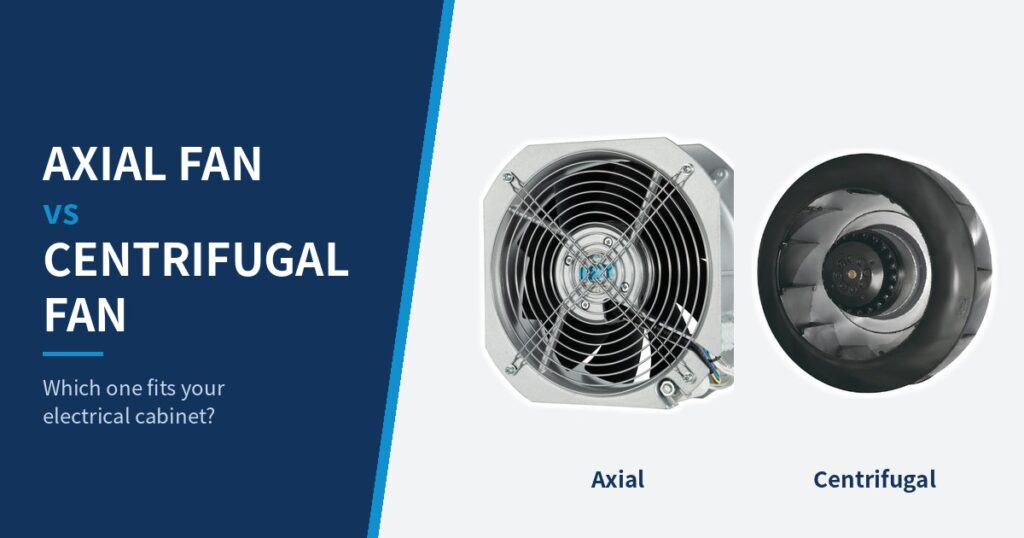
An axial fan moves air parallel to the fan’s shaft, using blades that function similarly to a propeller. Air enters and exits along the same axis, which allows axial fans to move large volumes of air with relatively low energy input and low noise, provided the downstream resistance stays low.
Key characteristics of axial fan airflow:
- High free-air volumetric flow rate relative to size and power draw
- Performance curve drops steeply as static pressure increases
- Generally simpler, more compact, and more cost-effective per unit of airflow
- Well suited to open enclosures, direct panel-to-ambient exchange, and low-restriction ventilation paths
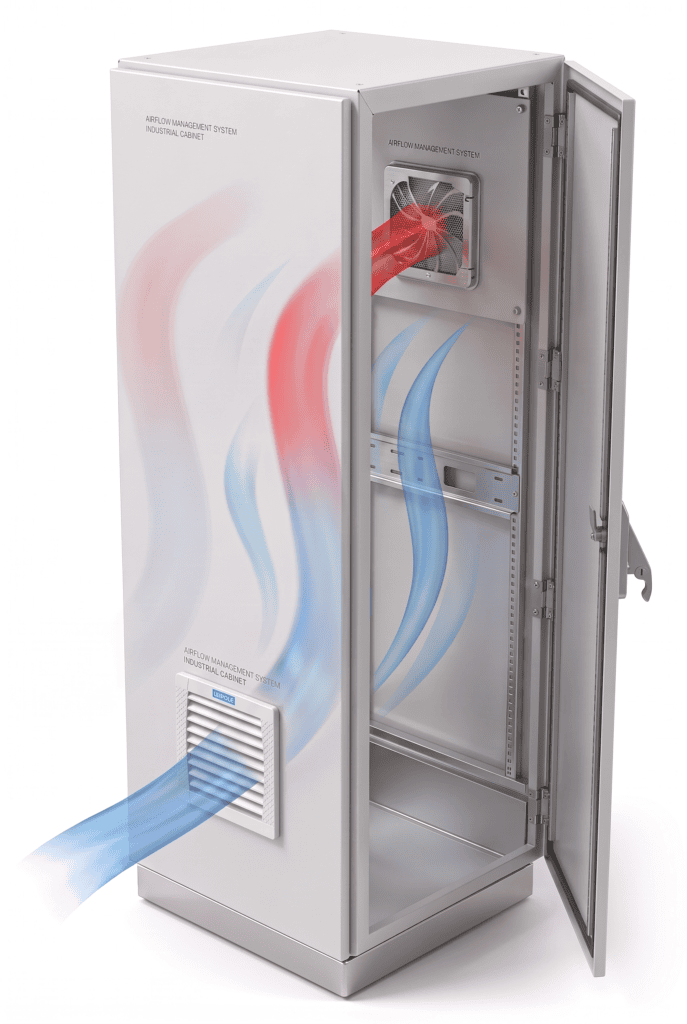
Axial fans are typically the first choice for axial fan for electrical cabinet applications where the airflow path is short and largely unobstructed — for example, a filtered vent panel with a straightforward intake and exhaust layout.
How Centrifugal Fans Work
A centrifugal fan (also called a blower or radial fan) draws air in along the axis and accelerates it outward at a 90-degree angle using a rotating impeller, converting velocity into pressure as air is pushed through the fan housing. This design fundamentally changes how the fan behaves under resistance.
Key characteristics of centrifugal fan performance:
- Higher static pressure capability at a given airflow rate compared to axial designs of similar size
- Airflow holds up better across a range of system resistance
- Generally more effective when air has to travel through ducting, tight enclosure paths, or dense filtration
- Often used where directional airflow control or distribution to a specific point is required
Because of this pressure-holding behavior, centrifugal fan for electrical enclosure applications are common wherever the airflow path includes real resistance — not just an open vent.
Axial Fan vs Centrifugal Fan: Comparison Table
| Characteristic | Axial Fan | Centrifugal Fan |
|---|---|---|
| Airflow direction | Parallel to shaft (straight through) | Perpendicular to shaft (90° turn) |
| Free-air airflow | Generally higher | Generally lower |
| Static pressure capability | Lower, drops quickly under resistance | Higher, holds up under resistance |
| Best system resistance range | Low to moderate | Moderate to high |
| Typical noise at equivalent airflow | Generally lower in open-path use | Can be higher, depending on design and load |
| Footprint / mounting | Compact, low profile | Typically larger housing |
| Cost per unit airflow (free air) | Generally lower | Generally higher |
| Common enclosure use case | Open vents, direct exhaust, fan-filter units | Filtered/ducted cabinets, heat exchanger assist, dense enclosures |
| Sensitivity to filter loading | High — airflow drops significantly as filter clogs | Lower — better tolerance to added resistance |
Actual performance varies by fan model, blade design, motor type, and manufacturer — these are general engineering tendencies, not fixed values, and should always be checked against the specific fan’s published performance curve.
Application-Based Fan Selection Matrix
| Application | Typical Airflow Path | Generally Recommended Fan Type | Notes |
|---|---|---|---|
| Control cabinet, open vent + exhaust filter | Short, low resistance | Axial | Standard fan-and-filter or fan-and-louver setup |
| Fan-filter unit (FFU) with dust filter | Moderate resistance, increases as filter loads | Axial (light duty) or Centrifugal (heavier filtration) | Depends on filter class and expected dust loading |
| Automation panel with internal ducting | Moderate to high resistance | Centrifugal | Ducting adds pressure drop axial fans struggle to overcome |
| Machine tool enclosure, coolant/particulate-heavy environment | High resistance, dense filtration | Centrifugal | Static pressure retention matters more than peak CFM |
| Sealed cabinet with air-to-air heat exchanger | Fan works against exchanger core resistance | Centrifugal (internal circulation) + Axial (external) | Hybrid setups are common; internal and external fans serve different roles |
| Large enclosure, direct-to-ambient exhaust | Low resistance, high volume needed | Axial | Prioritizes airflow volume over pressure |
| Enclosure with directional spot cooling requirement | Requires focused airflow to a specific zone | Centrifugal | Pressure allows air to be directed rather than dispersed |
This matrix reflects general engineering tendencies. The correct choice for a specific automation panel or machine tool enclosure should always be confirmed against the actual system resistance curve and the fan manufacturer’s performance data.
Filters, Grilles, Ducts, and Heat Exchangers: How They Change the Decision
Cabinet cooling fan selection cannot be separated from what the fan is pushing air through. The same fan can be an excellent choice in one enclosure and a poor one in another, purely based on downstream resistance.
- Filters: A clean filter adds modest resistance; a loaded filter can add substantially more. Fan selection should account for filter condition across the maintenance interval, not just when it’s new.
- Grilles and louvers: Louvered vents add resistance compared to open grilles, and the effect compounds with airflow velocity.
- Ducting: Every duct run, bend, and transition adds static pressure loss. Long or narrow ducting paths generally favor centrifugal fans.
- Heat exchangers (air-to-air or air-to-water): These typically present significant resistance due to fin density. Centrifugal fans are commonly paired with heat exchanger cores for this reason.
- Internal component density: Tightly packed control cabinets restrict internal air circulation, which can matter as much as the external vent path.
A fan selected purely on the enclosure’s external vent design, without accounting for internal resistance, is a common source of underperformance in the field.
When to Choose an Axial Fan
Axial fans are generally the appropriate choice when:
- The airflow path is short and largely unobstructed
- The enclosure uses a straightforward vent-and-filter or vent-and-exhaust configuration
- High airflow volume is the priority and static pressure requirements are low
- Cost per unit of airflow and compact mounting are priorities
- The application is a standard control cabinet, automation panel, or general-purpose electrical enclosure without ducting or heat exchangers
Typical use cases: general control cabinets, panel exhaust fans, fan-filter units in low-dust environments, direct-to-ambient cooling.
When to Choose a Centrifugal Fan
Centrifugal fans are generally the appropriate choice when:
- The airflow path includes ducting, bends, or extended runs
- The enclosure uses dense or multi-stage filtration
- A heat exchanger or cooling coil sits in the airflow path
- Airflow needs to be directed to a specific zone rather than dispersed
- System resistance is expected to increase over time (e.g., filter loading in dusty environments) and airflow needs to remain stable
Typical use cases: machine tool enclosures in particulate-heavy environments, ducted automation panels, cabinets paired with air-to-air or air-to-water heat exchangers, applications requiring consistent airflow despite variable resistance.
In many industrial systems, axial and centrifugal fans are used together — axial fans for open-path ventilation and centrifugal fans for pressure-critical zones such as heat exchanger cores or ducted sections — rather than treating the decision as strictly either/or.
Practical Fan Selection Process for Electrical Cabinets
A defensible electrical enclosure fan selection process generally follows these steps:
1. Calculate the Heat Load
Determine total internal heat dissipation (W) from all components — VFDs, PLCs, power supplies, transformers, and other heat-generating devices — under expected operating and ambient conditions.
2. Determine Required Airflow
Using the heat load, target internal temperature rise, and ambient temperature, calculate the airflow needed to maintain the enclosure within its rated operating temperature. This gives a required airflow figure — but this is only the starting point, not the final fan spec.
3. Estimate System Resistance
Map the full airflow path: intake grille, filter (new and loaded), internal component layout, ducting if present, and exhaust path. Each element contributes to total static pressure loss.
4. Plot the Operating Point on the Fan Performance Curve
Overlay the system resistance curve on the candidate fan’s published performance curve. The intersection — the actual operating point — indicates the real airflow the fan will deliver in that system, which is typically lower than the free-air rating.
5. Confirm Voltage and Motor Compatibility
Match fan voltage (e.g., 24VDC, 115VAC, 230VAC) and motor type to the control system and power availability, including inrush and continuous current draw for the control circuit.
6. Account for Environmental Conditions
Consider ambient temperature range, altitude (which affects air density and cooling performance), dust or particulate exposure, humidity, and any IP/NEMA rating requirements for the fan and enclosure assembly.
7. Validate Against Real-World Margins
Build in margin for filter loading over time, seasonal ambient variation, and future heat load increases from equipment upgrades — rather than sizing exactly to a single worst-case snapshot.
Skipping any of these steps — particularly step 4 — is where most fan selection errors originate.
Common Fan Selection Mistakes
- Selecting based on free-air CFM alone. Free-air ratings don’t reflect performance once a filter, duct, or heat exchanger is added to the system.
- Ignoring filter loading over the service interval. A fan sized for a clean filter may underperform significantly by the time the filter needs replacement.
- Treating all axial or centrifugal fans as interchangeable. Performance varies meaningfully by blade design, motor type, and manufacturer; two axial fans with similar CFM ratings can behave very differently under load.
- Oversizing “to be safe.” Oversized fans can increase noise, energy draw, and dust ingress rate without meaningfully improving cooling, and may pull in more particulate through the filter than necessary.
- Undersizing static pressure capability in ducted systems. An axial fan chosen for a ducted or heat-exchanger-equipped cabinet often cannot maintain adequate airflow against the added resistance.
- Not checking voltage and control compatibility early. Fan selection is sometimes finalized before confirming available voltage, leading to late-stage redesigns.
- Ignoring environmental derating. Altitude, high ambient temperature, and humidity can all reduce effective fan performance and are often left out of initial calculations.
Frequently Asked Questions
What is the main difference between axial and centrifugal fans? Axial fans move air parallel to the fan shaft and generally deliver higher free-air airflow at lower static pressure. Centrifugal fans move air at a 90-degree angle through a rotating impeller and generally maintain airflow better under higher static pressure, such as when filters or ducting are present.
Which fan is better for electrical cabinet cooling: axial or centrifugal? Neither is universally better. Axial fans are typically suited to open, low-resistance airflow paths, while centrifugal fans are typically better suited to cabinets with filters, ducting, or heat exchangers that add significant static pressure. The correct choice depends on the system’s resistance curve and operating point.
Does a higher CFM rating mean better cooling performance? Not necessarily. A fan’s free-air CFM rating only applies under zero resistance. Once filters, grilles, or ducting are added, actual airflow at the operating point can be substantially lower, which is why the fan’s full performance curve — not just its peak CFM — should guide selection.
Can axial and centrifugal fans be used together in the same enclosure? Yes. It’s common to use axial fans for open-path ventilation and centrifugal fans for pressure-critical zones, such as pushing air through a heat exchanger core or ducted section, within the same cooling system.
How does static pressure affect fan selection for a control cabinet? Static pressure represents the resistance the fan must overcome from filters, grilles, ducting, or internal components. A fan that cannot maintain adequate airflow at the system’s actual static pressure will underperform, regardless of its free-air rating — making static pressure a critical factor in electrical enclosure fan selection.
Choosing the Right Fan for Your Enclosure Cooling System
Fan selection for electrical cabinets is a system-level engineering decision, not a matter of picking the fan with the highest CFM rating on paper. Airflow requirements, static pressure, system resistance, and the fan’s actual performance curve all need to align with the specific cabinet’s heat load and airflow path.
LEIPOLE works with electrical enclosure designers, OEM engineers, and industrial equipment manufacturers to evaluate cabinet cooling requirements and identify axial, centrifugal, or hybrid fan configurations suited to the actual operating conditions — including filtration, ducting, and heat exchanger integration. If you’re working through a fan selection decision for a control cabinet, automation panel, or industrial enclosure, our team can help review your airflow requirements and system resistance against available fan performance data.