In large-scale data centers, the UPS battery room is typically an unattended yet mission-critical area. Hundreds or even thousands of lead-acid batteries are densely installed, continuously generating heat. More importantly, during the final stage of charging, they release flammable gases. If these gases accumulate locally in an enclosed space, even a small electrical arc—such as from a relay operation—can trigger an explosion.
This is precisely why project owners and safety inspectors consistently raise a critical question during design reviews:
Why must a data center battery room be equipped with exhaust fans? Isn’t internal air circulation from precision air conditioning sufficient?
The answer is straightforward: it is not sufficient.
This article takes a practical engineering perspective to explain how proper fan selection, airflow organization, and control strategies are essential to ensuring safety in data center battery rooms.

1. Why Ventilation Is Mandatory: Hydrogen Risk and Mechanical Ventilation Principles
Let’s start with the core issue.
When utility power fails, the UPS system must support the entire facility load, relying on large battery banks. Although lithium-ion batteries are becoming more common, valve-regulated lead-acid (VRLA) batteries are still widely used, especially in cost-sensitive projects.
This introduces a critical challenge:
How do we manage hydrogen gas released during charging?
From an electrochemical standpoint, during float charging—and especially at the end of equalization charging—water electrolysis intensifies, producing hydrogen and oxygen gases. Hydrogen is extremely light (approximately 1/14 the density of air) and quickly rises, accumulating near the ceiling in stagnant zones.
According to current standards, when hydrogen concentration in air reaches 4%, it hits the lower explosive limit (LEL).
At that point, even explosion-proof lighting or switches cannot eliminate the risk.
The only effective physical solution is dilution and removal.
Therefore, ventilation in battery rooms is not optional—it is a mandatory safety requirement.
Some may suggest natural ventilation, such as installing large louvers. However, the limitations of natural ventilation are obvious—it depends entirely on external wind conditions. When wind pressure is insufficient or unfavorable, hydrogen cannot be effectively discharged.
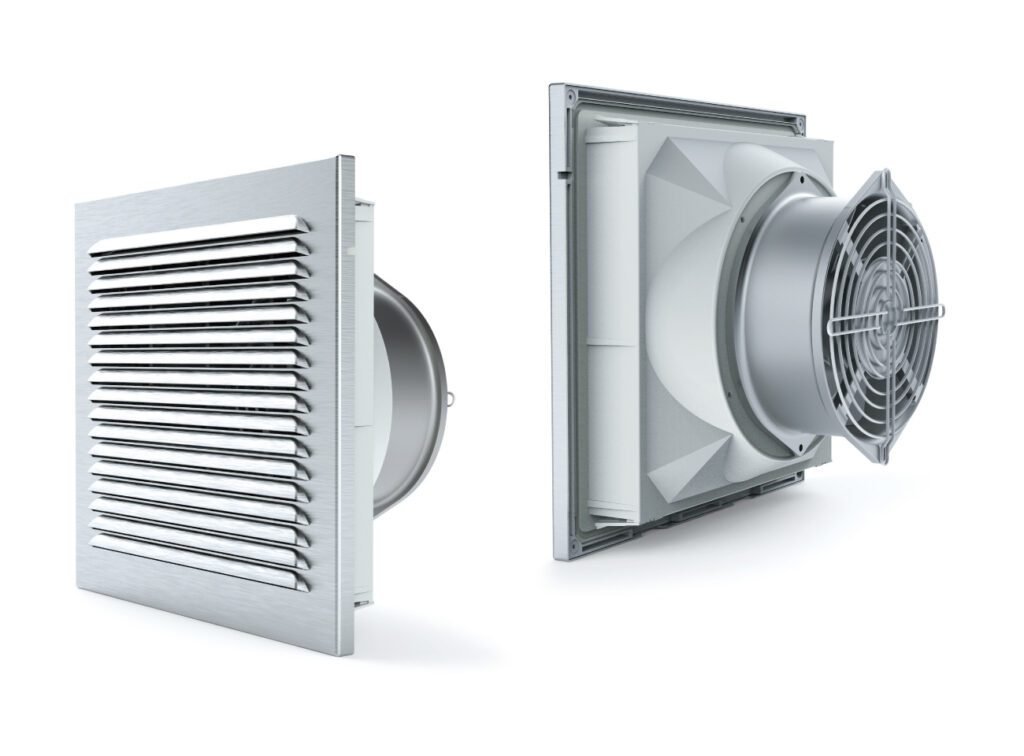
For large data centers, mechanical ventilation is the only reliable solution. Explosion-proof exhaust fans provide a stable and calculable air exchange rate, ensuring continuous removal of flammable gases. At the same time, they assist in dissipating heat generated by the batteries, reducing the risk of thermal runaway.
2. Battery Room Ventilation Design: Fans, Airflow, and Monitoring Integration
Once the fundamentals are clear, ventilation system design becomes a matter of applied fluid dynamics.
A complete UPS battery room ventilation system should include:
- Explosion-proof exhaust fans (primary equipment)
- Air intake louvers or duct systems
- Hydrogen detectors installed at the highest ceiling points
- Distributed temperature sensors
- A control panel integrated with the Building Automation System (BAS/BMS)
Airflow Organization: A Critical Design Factor
One of the most common mistakes in data center ventilation design is improper fan placement.
Since hydrogen is extremely light, exhaust outlets must be positioned at high levels (ceiling level) to capture accumulated gas. Air intake, on the other hand, should be located at low levels or introduce fresh air from outside.
This creates a bottom-to-top airflow pattern, effectively sweeping hydrogen and heat out of the room.
A common engineering pitfall is airflow short-circuiting. If intake and exhaust points are too close, fresh air is immediately extracted without circulating through the battery racks. This leaves stagnant zones where hydrogen can accumulate.
Therefore, airflow design must ensure full coverage of all battery areas with no dead zones.
Redundancy and System Integration
In large-scale projects, fan configurations typically adopt redundancy (e.g., N+1 or duty/standby). These fans are integrated with hydrogen sensors and environmental monitoring systems.
This forms a closed-loop control system:
- Sensors monitor real-time conditions
- Control panels execute commands
- BMS records and manages system status
3. Operating Conditions and Control Logic: Intelligent Fan Operation
A well-designed system is not just about hardware—it requires intelligent control logic.
Normal Operation
Under normal conditions (utility power stable, batteries in float charge), gas generation is minimal. Fans typically operate intermittently at low speed—for example, running 20 minutes every two hours—to maintain basic air circulation.
Charging Peaks
After a power outage, when UPS systems perform high-current recharge (equalization charging), gas generation peaks. At this stage:
- Fans switch to high-speed operation
- Forced ventilation removes both gas and heat
Emergency Conditions and Safety Logic
Safety design must account for worst-case scenarios.
In a properly designed control system:
- If hydrogen concentration approaches alarm thresholds (typically 1%–2%, well below LEL),
→ All primary and standby fans immediately operate at full capacity
→ Audible and visual alarms are triggered
→ BMS generates real-time alerts
If the primary fan fails (e.g., motor failure or bearing seizure):
- Differential pressure switches or current sensors detect failure
- The system automatically switches to the standby fan within milliseconds
Fire Protection Interlock: A Critical Boundary Condition
A key engineering boundary condition must be clearly defined:
- During a power outage, fans remain operational via emergency power (diesel generators) to maintain ventilation
- However, in the event of a confirmed fire (triggered by dual smoke and heat detection),
→ The fire suppression system takes priority
→ All non-fire-related power is cut off
→ Exhaust fans and dampers are shut down
This ensures that the extinguishing agent can reach the required concentration.
Under no circumstances should fans continue operating and supply oxygen to a fire.
Final Note: Engineering Validation Matters
In engineering, safety is never theoretical.
Battery room exhaust fans are relatively low-cost components, yet they protect:
- High-value battery systems
- Mission-critical infrastructure
- Overall facility safety
During commissioning, do not simply check whether the fans are running. Instead:
- Use calibrated gas to test hydrogen detectors
- Verify automatic switching between primary and standby fans
- Confirm that airflow performance meets design requirements
That is where real system reliability is proven.