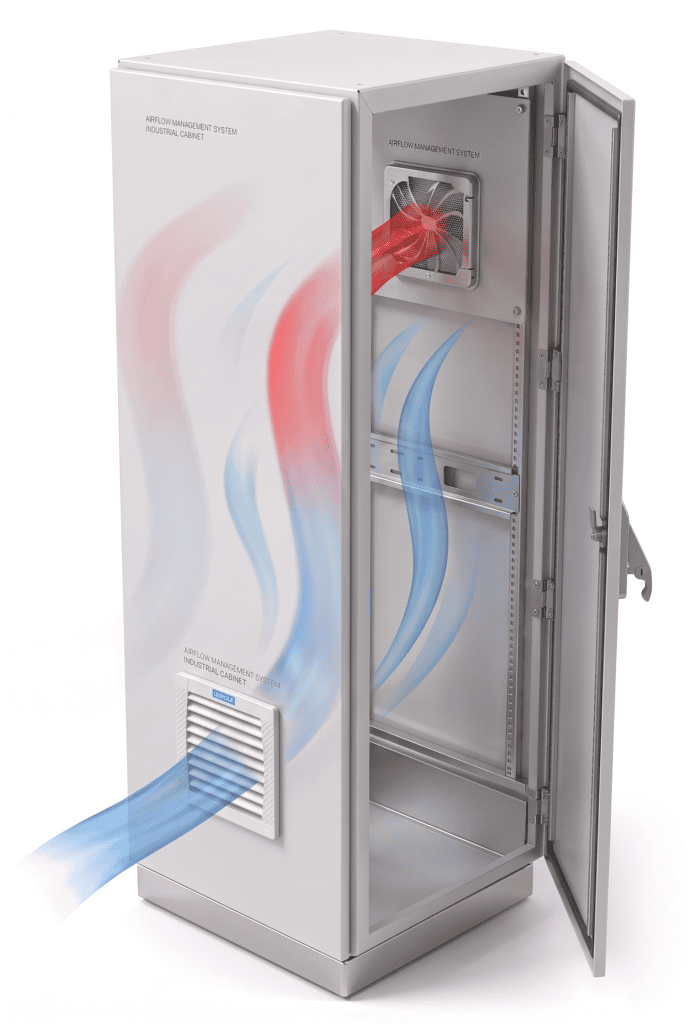
Your electrical enclosure is designed to protect sensitive components, but it also traps the heat they generate. If this internal temperature exceeds component ratings, you risk premature failure, costly downtime, or even a fire hazard.
Calculating the enclosure heat transfer load is the most critical step in designing a reliable thermal management system. Yet, many engineers are left confused by empirical formulas, conflicting units, and unclear variables.
This guide provides a clear, step-by-step engineering approach to accurately calculate your heat load, determine if natural convection is sufficient, and correctly size a fan for forced ventilation.
🌡️ Why Accurate Heat Load Calculation is Critical
Thermal management is a balancing act.
- Under-cooling: Leads to component temperatures exceeding their rated maximum (Ti), causing system failure.
- Over-cooling: Selecting a massively oversized air conditioner or fan wastes capital, consumes unnecessary energy, and increases operational costs.
An accurate calculation allows you to precisely match your cooling solution to your heat load, ensuring reliability and efficiency. This process begins with understanding the core physics of heat transfer.
Understanding the Core Heat Transfer Formula
All enclosure heat transfer calculations are based on the same principle, which is often compared to an electrical circuit:
Heat Flow (Current) = Temperature Difference (Voltage) / Thermal Resistance (Resistance)
The total heat (Q) an enclosure can dissipate through its surfaces is governed by the classic formula Q = U * A * ΔT, where:
- Q = Total heat transfer (W)
- U = Overall heat transfer coefficient (W/m²·K)
- A = Surface area of the enclosure (m²)
- ΔT = Temperature difference between inside and outside (K or °C)
The “trick” is finding U, which is the inverse of the total thermal resistance (R_total). This resistance is a series of three barriers:
- Internal Convection: Heat moving from the internal air to the cabinet wall (1/hi).
- Conduction: Heat moving through the cabinet wall (R_wall).
- External Convection: Heat moving from the cabinet wall to the ambient air (1/ho).
This gives us the complete relationship: 1/U = 1/hi + R_wall + 1/ho
The Common (and Confusing) Formula
You may have seen an empirical formula that looks like this: q = (To - Ti) ÷ [ (1/ho) + (1/hi) + R ] × 5.67
This formula is fundamentally correct in principle but presents two major problems:
- The Sign Convention (To – Ti): This calculates the temperature difference from outside to inside. If the inside is hotter (e.g., Ti=40°C, To=25°C), the result is negative. This merely indicates heat is flowing out of the enclosure, but it’s often confusing.
- The “5.67” Constant: This is the biggest pitfall. This number is not a physical constant. Instead, it is almost certainly a unit conversion factor used to make a formula based on Imperial units (like BTU/hr·ft²·°F) work with SI-like inputs.
Using this constant without knowing its exact origin and unit system will lead to significant errors.
The Recommended SI Unit Formula (The Professional Method)
For clear, accurate, and universally understandable results, always use standard SI units. When you do, the confusing constant disappears, and the formula becomes clean:
q = (Ti – To) / R_total
Where:
- q = Heat transfer load per unit area (W/m²)
- Ti = Max. allowed internal enclosure temperature (°C)
- To = Max. external ambient temperature (°C)
- R_total = Total thermal resistance (m²K/W)
And R_total is calculated as: R_total = 1/hi + R_wall + 1/ho
- hi = Internal convective heat transfer coefficient (W/m²·K)
- ho = External convective heat transfer coefficient (W/m²·K)
- R_wall = Thermal resistance of the enclosure wall (m²K/W)
With this formula, a positive q value means heat is flowing out of the enclosure, which is exactly what we want to calculate.
Two Key Engineering Goals for Your Calculation
Your calculation will answer one of two questions. It’s vital to know which one you’re asking.
Goal 1: Heat Dissipated by the Enclosure (Natural Convection)
- The Question: “My components produce X Watts. Can my sealed enclosure dissipate this heat on its own without a fan?”
- The Method: You calculate the total heat the enclosure can dissipate (Q_shell) and compare it to the heat your components generate (Q_gen).
Goal 2: Required Airflow for Forced Ventilation (Fan Selection)
- The Question: “My components produce X Watts, which is more than the enclosure can handle. What size fan do I need to remove the extra heat?”
- The Method: You calculate the excess heat (Q_excess) and then use an airflow formula to find the required volumetric flow rate (CFM or m³/h) for a fan.
A Step-by-Step Guide to Calculating Your Cooling Needs
Let’s walk through the full engineering process using SI units.
Step 1: Gather Your Inputs (SI Units)
- Q_gen (W): Total heat generated by all components inside the enclosure (in Watts).
- Ti (°C): The maximum allowable internal temperature. This is usually the lowest max operating temp of your most sensitive component (e.g., PLC, VFD).
- To (°C): The maximum expected ambient temperature outside the enclosure.
- A (m²): The effective heat-dissipating surface area of the enclosure. (Note: The bottom is often excluded. For standalone cabinets, use the top and four sides).
- hi & ho (W/m²·K): Convective coefficients. If unknown, use conservative empirical values:
- hi (internal): ~1.6 – 2.5 (still air), 6+ (with an internal circulation fan).
- ho (external): ~1.6 (still air), 2.5 (light breeze), 6.0 (moderate wind).
- Rule of Thumb: Be conservative. Using small h values assumes worse heat transfer, giving you a safer design.
- R_wall (m²K/W): Wall thermal resistance. For a standard single-layer metal sheet (steel, aluminum), conduction is so high that R_wall is often negligible (close to 0). It only becomes significant for insulated or thick plastic enclosures.
Step 2: Calculate Total Thermal Resistance (R_total)
Use the values from Step 1.
- Example: For a standard metal cabinet in a still-air room.
- hi = 1.6 W/m²·K
- ho = 1.6 W/m²·K
- R_wall ≈ 0
- R_total = (1 / 1.6) + 0 + (1 / 1.6) = 0.625 + 0.625 = 1.25 m²K/W
Step 3: Find the Heat Transfer Rate (q)
Calculate the heat transferred per square meter of surface area.
- Example: We require Ti = 45°C and the ambient To = 30°C.
- ΔT = Ti – To = 45 – 30 = 15°C (or 15 K)
- q = ΔT / R_total = 15 / 1.25 = 12 W/m²
Step 4: Determine Total Heat Dissipation via the Enclosure (Q_shell)
This is the total power your enclosure can naturally dissipate.
- Example: Your enclosure is 1.2m high, 0.8m wide, 0.4m deep.
- Area (Top): 0.8 * 0.4 = 0.32 m²
- Area (Sides): 2 * (1.2 * 0.8) + 2 * (1.2 * 0.4) = 1.92 + 0.96 = 2.88 m²
- Total Area A = 0.32 + 2.88 = 3.2 m²
- Q_shell = q * A = 12 W/m² * 3.2 m² = 38.4 W
This is your GOAL 1 answer. This cabinet, in this environment, can naturally dissipate 38.4 Watts of heat.
Step 5: Compare and Calculate Required Airflow (q_air)
Now, compare Q_shell to your actual internal heat Q_gen.
- Scenario A: Your Q_gen is 25 W.
- 25 W < 38.4 W (Q_gen < Q_shell).
- Conclusion: You are safe. Natural convection is sufficient.
- Scenario B: Your Q_gen is 500 W.
- 500 W > 38.4 W (Q_gen > Q_shell).
- Conclusion: You need forced ventilation.
First, find the excess heat you must remove:
- Q_excess = Q_gen – Q_shell = 500 W – 38.4 W = 461.6 W
Now, use the airflow formula (this is GOAL 2): q_air = Q_excess / (C * ΔT_air)
- q_air = Required volumetric airflow (in m³/s)
- Q_excess = Excess heat to remove (in Watts)
- C = Volumetric heat capacity of air (≈ 1200 J/(m³·K)). This is a reliable physical constant.
- ΔT_air = The permissible temperature rise of the cooling air as it passes through the cabinet (in °C or K). Note: This is not Ti – To. It’s a design choice, typically 5°C to 10°C.
- Example: Let’s choose a ΔT_air of 10°C (we let the fan’s exhaust air be 10°C hotter than its intake air).
- q_air = 461.6 W / (1200 J/(m³·K) * 10 K) = 0.0385 m³/s
Finally, convert this to common fan units to make your selection:
- In m³/h: 0.0385 * 3600 = 138.6 m³/h
- In CFM: 0.0385 * 2119 = 81.6 CFM
You would then select a fan (or fan/filter assembly) that provides at least this much airflow, adding a safety margin (e.g., 20-50%).
🔧 Practical Considerations for Real-World Applications
- What if (Ti – To) is Negative? If the outside air (To) is hotter than your allowed inside temperature (Ti), your q will be negative. This means heat is entering the cabinet. This external heat gain must be added to your Q_gen and removed by an active cooling solution like an air conditioner.
- Solar Gain: For outdoor enclosures, direct sunlight adds a significant heat load (Q_solar). This must be calculated separately and added to Q_gen. Using a solar shield or painting the enclosure white can dramatically reduce this.
- The Insulation Trade-off: Adding insulation (a high R_wall) is beneficial only if your primary problem is a hot external environment (To > Ti). If your main problem is high internal generation (Q_gen), insulation is harmful as it traps heat, reducing Q_shell and increasing your reliance on fans.
- Internal Fans: Using a small internal fan to circulate air inside the cabinet (not for ventilation) can dramatically increase hi, breaking up hot spots, and improving heat transfer to the walls.
The Right Solution: From Natural Dissipation to Forced Air
This calculation-based approach empowers you to choose the right solution.
- If Q_gen < Q_shell, your enclosure is safe.
- If Q_gen > Q_shell, you have an excess heat load (Q_excess) that must be removed.
For reliable forced air cooling, you need high-quality fans designed for continuous operation and capable of overcoming the pressure drop from filters. LEIPOLE’s range of axial fans (https://leipole.com.sg/product/axial-fans/) provides certified airflow (measured in CFM or m³/h) to effectively remove Q_excess and maintain your target Ti.
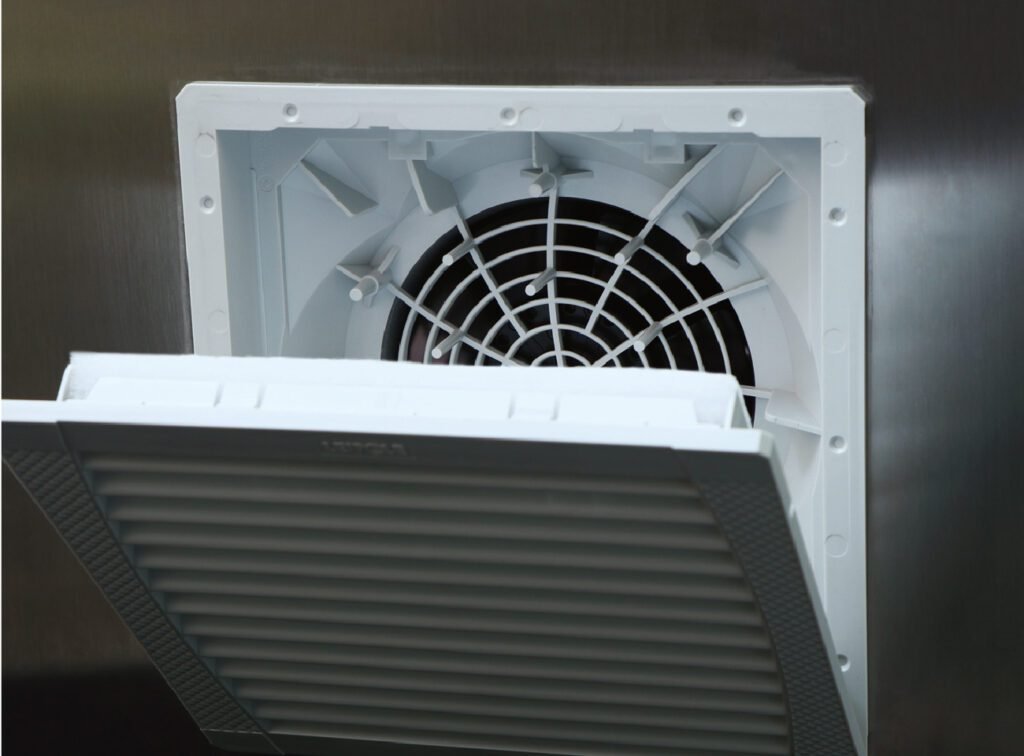
By moving from guesswork to a clear, five-step calculation, you can ensure the long-term reliability of your critical components.
Frequently Asked Questions (FAQ)
Q: What are typical ‘h’ (convective heat transfer coefficient) values? A: Common empirical values in W/m²·K are: 1.6 for still air, 2.5 for light air movement, and 6.0 or higher for forced air/wind. Always use conservative (lower) values for your calculations to ensure a safe design.
Q: How do I account for direct sunlight on an outdoor enclosure? A: Direct sunlight (solar heat gain) must be treated as an additional heat load. This value (Q_solar), measured in Watts, should be added to your internal component heat generation (Q_gen) before you calculate your total cooling requirement.
Q: How do I convert airflow units for fan selection? A: To convert from the SI unit of cubic meters per second (m³/s) to more common fan specifications:
- To get cubic meters per hour (m³/h): Multiply m³/s by 3600.
- To get cubic feet per minute (CFM): Multiply m³/s by 2119.
Q: Is more insulation (a higher R-value) always better? A: Not necessarily. Insulation is a trade-off. It’s beneficial if the outside (ambient) temperature is hotter than your desired internal temperature, as it reduces heat gain. However, if your internal components generate significant heat, insulation will trap that heat, making it harder to dissipate and increasing the need for forced ventilation.
To simplify this process, you can also use LEIPOLE’s Electrical Cabinet Cooling Fan Selection Tool (https://leipole.com.sg/leipole-electrical-cabinet-cooling-fan-selection-tool/) to get a quick recommendation.