A cabinet cooling thermostat that switches frequently is giving you a symptom, not a diagnosis. Compare temperature at the sensor with temperature near the protected equipment. Check the model’s switching behaviour, the air path and the load cycle before changing the setting or replacing the fan.
The control problem often appears as a fan that starts, quickly stops and starts again, while another part of the cabinet remains warm. A thermostat responds to its own sensing location. It cannot directly represent every temperature inside a densely populated enclosure.
Confirm the cabinet cooling thermostat function
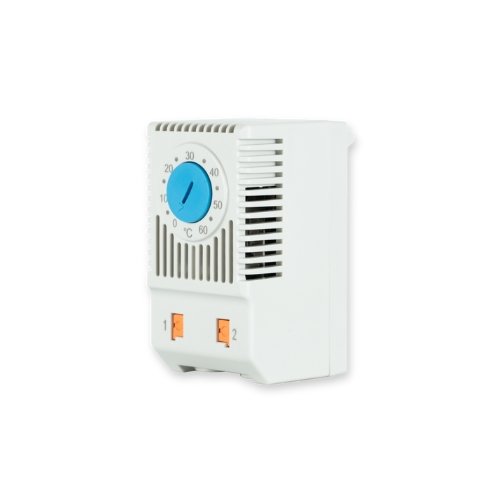
First identify the exact cooling thermostat model and its intended function. LEIPOLE distinguishes normally open cooling controls from normally closed heating controls in its heating and cooling thermostat range. Verify the product-specific contact behaviour and electrical ratings rather than relying on knob colour or a similar housing.
The JSK0011F cooling controller is one relevant product reference; suitability still depends on the installed fan load and the model’s instructions. Any electrical testing or connection changes should be carried out by qualified personnel with the equipment safely isolated.
Compare the cooling thermostat sensor with the hotspot
To assess cooling thermostat operation, record a temperature trend at the controller’s sensing location and near the equipment that needs protection, together with fan on/off events. Use consistent production conditions. If the sensor cools quickly as the fan starts but a distant region stays hot, investigate sensor placement and air distribution.
A direct inlet air stream, a nearby heat source or a shielded pocket of air can make the sensing point unrepresentative. Placement should follow the product instructions and the cabinet’s thermal design. Relocating the sensor without understanding the temperature pattern may simply move the problem.
Understand the cooling thermostat switching difference
A temperature control can have different switch-on and switch-off thresholds. The difference, often called switching differential or hysteresis, prevents every tiny change around one temperature from producing a state change. The actual behaviour and tolerances are model-specific; not every control provides an adjustable differential.
Do not invent a universal cooling thermostat setting such as “always switch at 40 °C” or assume the dial is the maximum temperature anywhere in the enclosure. Select and verify the operating condition against equipment limits, sensing location and the control’s documented behaviour.
| Observed pattern | Check next | Evidence to keep |
|---|---|---|
| Sensor cools quickly; remote equipment remains hot | Sensor exposure and airflow distribution | Temperatures at both positions and fan events |
| Switching follows a repeating machine cycle | Changes in component heat loss | Process state beside the temperature trace |
| Temperatures rise despite continuous fan operation | Inlet temperature, filter condition and airflow capacity | Load, ambient conditions and the installed configuration |
| Switching differs from documented behaviour | Model, settings, electrical compatibility and condition | Exact part reference and qualified inspection findings |
Do not use the cooling thermostat to hide an airflow problem
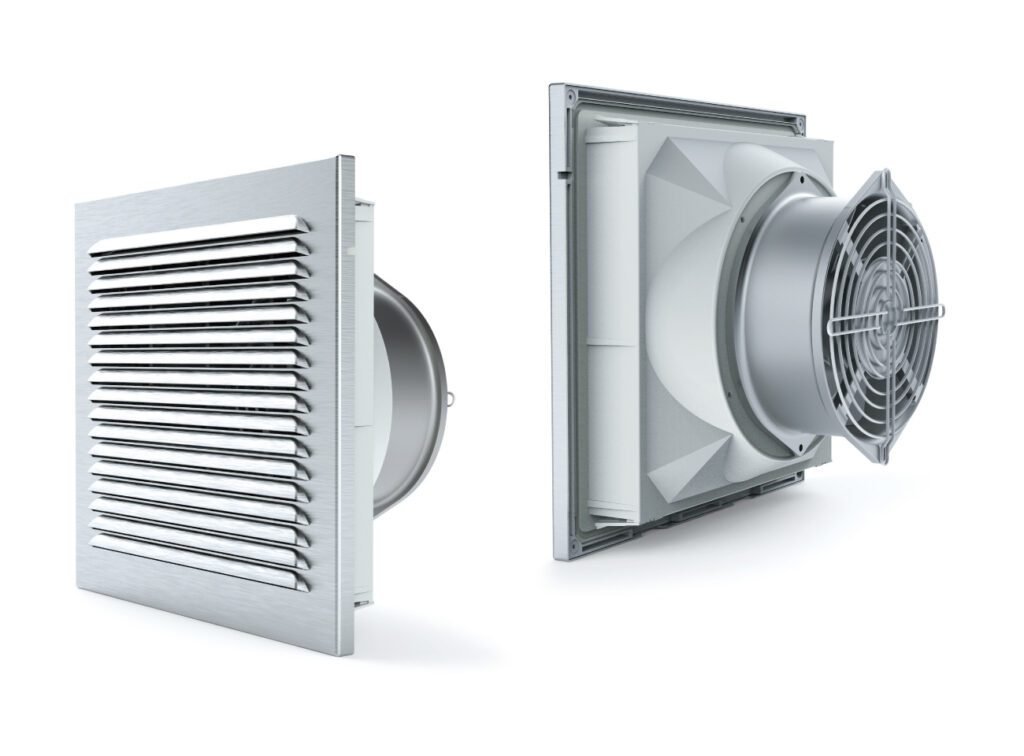
Lowering a setting cannot make ventilation cool below ambient. If the fan runs continuously but the target is not met, compare the real heat load and inlet temperature with the cabinet cooling fan calculation. Inspect filters and outlets and confirm that the fan’s installed delivery is adequate.
Likewise, repeatedly widening a control band is not a substitute for checking a hidden hotspot. Evaluate the temperature pattern and the equipment limits together. For a broader installation procedure, refer to the existing industrial thermostat installation guide.
Verify cabinet cooling thermostat changes under load
When reviewing a cooling thermostat, change one verified condition at a time and repeat the relevant operating cycle. Record the final setting, measurement positions, observed switching and highest equipment-area temperature. Keep any unresolved variation visible rather than declaring success from a quiet fan alone.
A useful result is stable, adequate cooling with documented control behaviour. Keep the record with the fan and controller references so that future replacements preserve the intended arrangement.
Review the fan and control together. Explore LEIPOLE thermostats and hygrostats and cabinet filter fans, then confirm a suitable combination for your installation.