A cabinet cooling commissioning test should demonstrate temperature control in the finished installation. Agree on the load, ambient conditions, measurement positions and equipment limits before testing. Keep the doors closed, the specified filters installed and a time record of both ambient and internal temperatures.
A cabinet cooling calculation supports selection. Commissioning checks whether the installed enclosure behaves as intended. These are different pieces of evidence: a fan’s catalogue rating does not describe every cable route, obstruction, filter and heat source in the completed panel.
Define the cabinet cooling commissioning conditions
For cabinet cooling, list the equipment to protect and its applicable temperature limits from current documentation. State the production states the test must cover, including any high-load cycle. Identify the expected worst cabinet cooling inlet conditions and explain whether the test can reproduce them.
If the available cabinet cooling test is milder than the design case, record that limitation. Do not label a short demonstration at low load as proof of full-duty thermal performance. An engineering review may be needed to bridge the difference between the observed conditions and the design envelope.
Choose repeatable cabinet cooling measurement positions
Record the ambient temperature at the air inlet rather than relying only on a distant room sensor. Use appropriate internal measurement positions near relevant equipment and expected hot regions. Keep sensors clear of electrical hazards and moving parts; installation and access should be handled by qualified personnel using the site’s isolation procedure.
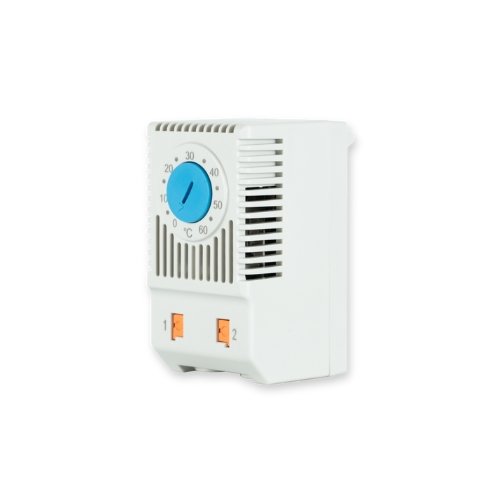
For cabinet cooling, include the thermostat’s sensing location if one controls the fan. A single sensor in the incoming air stream can miss a hotter area. Record sensor identification, placement, instrument accuracy and the sampling interval so the results can be interpreted later.
| Time / process state | Inlet °C | Protected location °C | Control state | Observation |
|---|---|---|---|---|
| Before load | Record | Record | Fan on / off | Initial conditions |
| Normal production | Record | Record | Fan on / off | Load and temperature trend |
| Relevant high-load cycle | Record | Record | Fan on / off | Highest observed temperature |
| Stable operating trend | Record | Record | Fan on / off | Compare with agreed limits |
Test cabinet cooling in its completed configuration
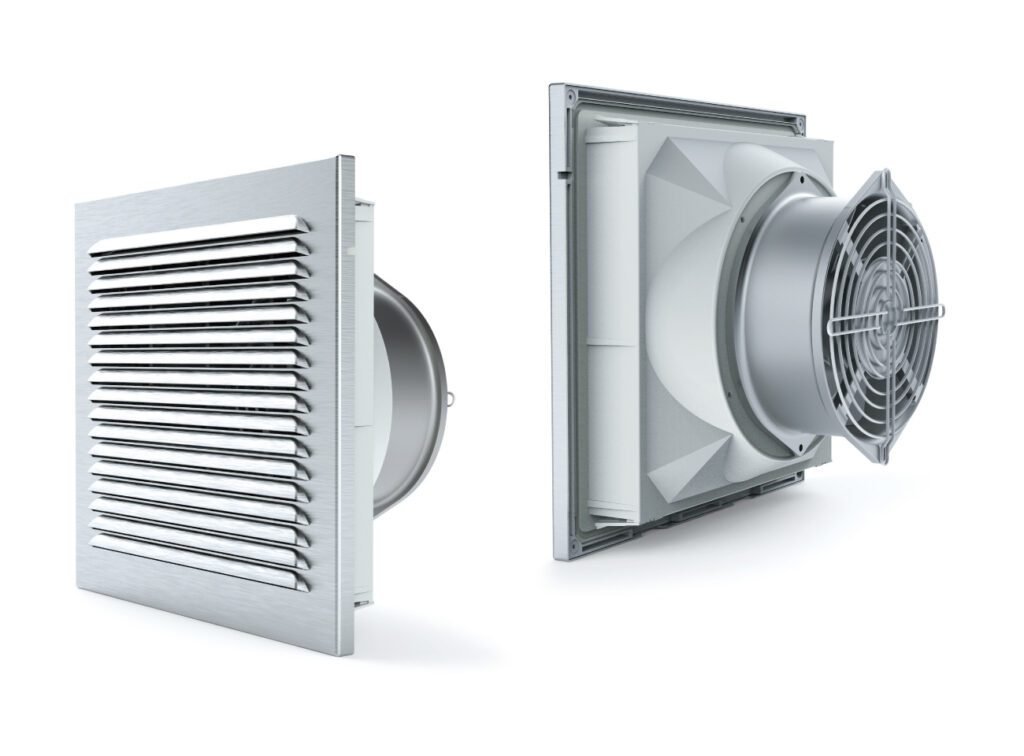
Confirm the selected cabinet cooling fan, outlet filter, media and enclosure openings match the approved arrangement. Check that installation clearances remain available after adjacent equipment and cable routes are in place. Perform operational measurements with the doors closed and the intended covers fitted.
Run the agreed cabinet cooling test conditions until the observed trend can be assessed. The required duration depends on the cabinet and duty cycle; this guide does not prescribe a universal number of minutes. Record any fan switching and any equipment alarm rather than keeping only the final temperature reading.
Explain the difference between sizing and measured cabinet cooling
The LEIPOLE airflow calculator reports the ventilation requirement from its existing heat-transfer method. It does not simulate every internal hotspot or the pressure loss of the installed system. Use its saved inputs to check whether the test matches the design case.
When cabinet cooling performance differs, review the evidence in order: actual heat loss, inlet temperature, material and accessible surface area, air-path restrictions, then the selected fan’s operating point. The static-pressure guide explains why catalogue free airflow and installed delivery can differ.
Close the cabinet cooling commissioning record
Document the cabinet cooling product references, controller settings, test conditions, recorded maximums and the acceptance decision. Keep outstanding conditions visible, including any untested ambient range or future equipment additions. Correct a failed condition and repeat the affected verification before signing it off.
Retain the cabinet cooling measurements from the clean system as the maintenance baseline. That makes future filter inspections and overheating complaints easier to compare with the installation that was originally accepted.
Connect selection to verification. Review filter fan configurations, save the design calculation and use the table above to record the installed result. For uncertain airflow or thermal conditions, request model-specific support from LEIPOLE.