Energy-efficient enclosure cooling starts with matching the cooling method to the real duty. Measure heat loss, temperature headroom and fan runtime before comparing equipment. A lower-power fan is useful only if it still removes the required heat through the installed air path.
Energy efficiency remains a practical purchasing topic for Singapore manufacturers. NEA’s Energy Efficiency Grant page describes support for investment in eligible efficient equipment and an extension to March 2027. This reflects the wider focus on measured improvements; it does not establish eligibility for a particular cabinet fan or project. Read the current NEA programme information.
For thermal control in a control panel, the useful starting point is smaller and more specific than a factory-wide target: understand where heat is generated, how it leaves the enclosure and when the cooling equipment actually needs to run.
Measure the baseline for energy-efficient enclosure cooling
For enclosure cooling, record the existing fan’s electrical input from appropriate product data or a qualified measurement, its operating schedule, and the cabinet’s temperature trend. Keep production load and ambient conditions beside the readings. Enclosure cooling energy use without a thermal record cannot tell you whether a change has maintained equipment protection.
As an illustrative cabinet cooling comparison, a 30 W fan running for 8,000 hours uses 240 kWh. If verified operation allows 4,000 hours at the same input, the arithmetic becomes 120 kWh. This is an example of runtime accounting, not a predicted saving for a LEIPOLE product or a reason to turn off necessary cooling.
Use temperature headroom to choose the enclosure cooling method
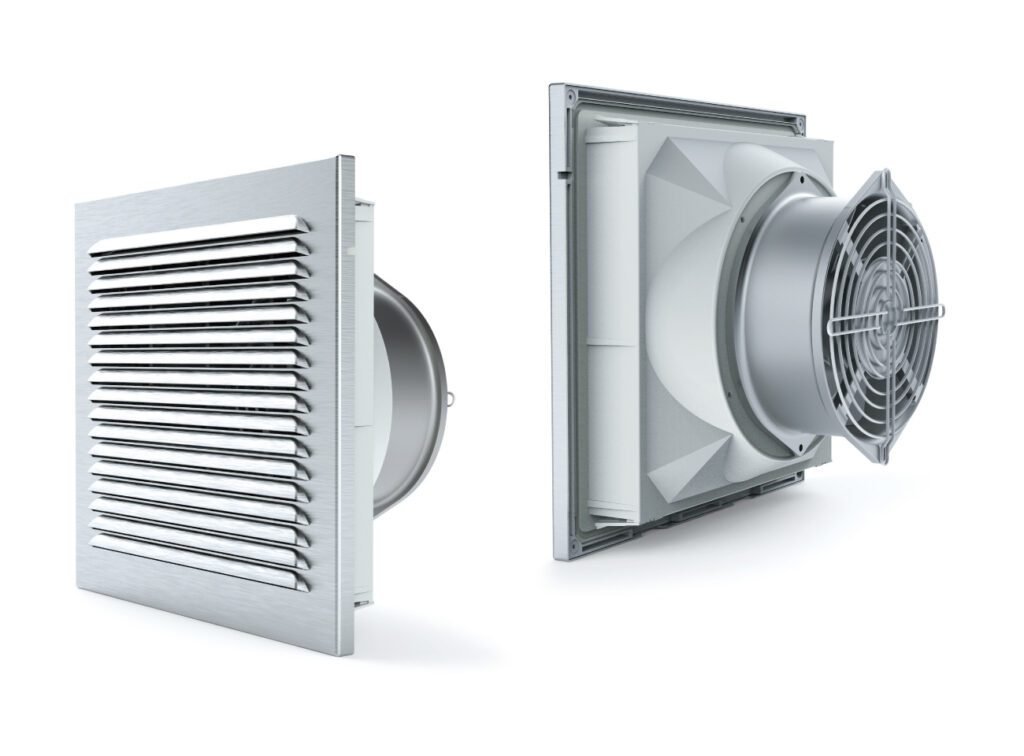
Filtered ventilation uses outside air and requires that air to be cooler than the target inside temperature. Where that condition is met and the environment permits ventilation, cabinet filter fans are a relevant starting point. Where the target is below ambient, fan speed alone cannot solve the temperature requirement.
Compare the actual conditions in the LEIPOLE airflow calculator. Change one input at a time and keep the original case for comparison. The tool preserves the existing heat-transfer formula; its illustration does not calculate pressure losses, solar heat gain or annual energy consumption.
Control enclosure cooling runtime without hiding hotspots
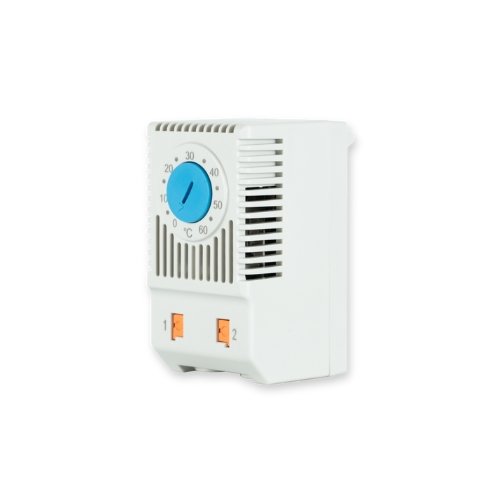
A suitably specified cooling thermostat can call for ventilation when its sensing location reaches the switching condition. The setting must account for the protected equipment’s limits and the difference between sensor temperature and the hottest component area.
Check enclosure cooling during several production states before changing a setting. A sensor exposed directly to the cool inlet can stop the fan while a remote hotspot remains warm. Frequent starts and stops also deserve investigation. Keep the model’s switching behaviour, contact rating and allowed control method in the review.
Protect energy-efficient enclosure cooling with the correct filters
Do not improve an airflow figure by removing the specified filter. Filtration, delivered airflow and maintenance access belong to the same design. A restrictive or damaged outlet can reduce useful cooling even while a fan continues to consume power.
Plan enclosure cooling maintenance around observed loading and the manufacturer’s instructions. Pfannenberg presents service access, filter configuration and optional thermostat operation as connected aspects of filter-fan operation. Those principles support reviewing the complete installation rather than comparing motor watts in isolation. See the manufacturer’s filter-fan overview.
| Improvement being considered | Keep this evidence | Reject the change if… |
|---|---|---|
| Temperature-based operation | Runtime and worst-case temperature before and after | A hotspot exceeds its allowed limit |
| Different fan or control method | Installed airflow, electrical compatibility and product data | The comparison only uses free-air ratings |
| Revised filter servicing | Media reference, loading observations and temperature baseline | Required filtration or enclosure protection is lost |
Approve enclosure cooling improvements with a repeatable test
Compare matched operating conditions and document the limits of the comparison. One short test during mild weather does not prove annual savings or performance through every production cycle. Where measurement is incomplete, state the remaining uncertainty instead of converting an estimate into a guarantee.
Retain the final enclosure cooling settings, product references and inspection responsibilities. The goal is a cooling arrangement whose operation can be explained and maintained, with any energy reduction supported by the same evidence that confirms adequate heat removal.
Review the complete cooling path. Start with the LEIPOLE enclosure cooling range, save your design inputs and discuss a suitable fan and control arrangement.