A cabinet cooling fan quotation is only comparable when the operating conditions are comparable. Send the required installed airflow, electrical supply, mounting dimensions, filter arrangement and environment together. A cabinet cooling fan model number and a nominal airflow alone leave important questions unanswered.
Panel builders procuring a cabinet cooling fan often receive quotations that look similar but describe different configurations. One figure may be free airflow; another may include an inlet filter; a third may apply at a different frequency. Resolving those differences before ordering is easier than modifying a finished door cut-out.
Prepare a cabinet cooling fan request that suppliers can answer
Start the cabinet cooling fan specification with the enclosure and the duty it must support. Include height, width, depth, material, installation arrangement, component heat loss, maximum expected inlet temperature and the target internal temperature. Identify whether the project is a replacement, a new panel or a repeat order.
For a cabinet cooling fan replacement, attach the existing label details and the mounting drawing. State which dimensions are fixed. Frame size, cut-out size and mounting depth are separate dimensions; similar-looking housings should not be treated as interchangeable.
| RFQ field | What to provide | Why it matters |
|---|---|---|
| Thermal duty | Heat loss in W; ambient and target temperatures in °C | Defines the cooling requirement |
| Airflow basis | Required m³/h at the intended filter and outlet arrangement | Prevents free-air and installed ratings being confused |
| Electrical supply | AC/DC, voltage, frequency and control method | Separates electrical variants of the same family |
| Mechanical envelope | Cut-out, panel thickness, available depth and clearances | Checks fit before metalwork |
| Environment | Dust, moisture, washdown exposure and temperature range | Defines protection and material requirements |
| Delivery package | Fan, outlet filter, media, seals, drawings and spare parts | Makes scope and future servicing explicit |
Compare cabinet cooling fan airflow on the same basis
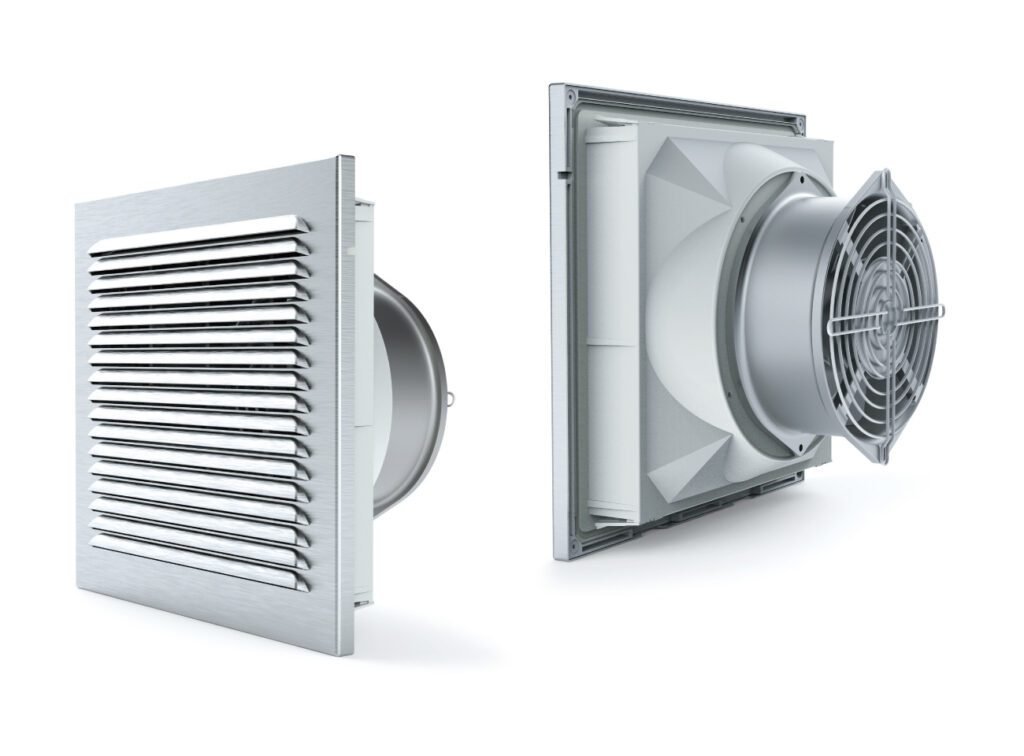
LEIPOLE’s filter fan range and axial fan range serve different arrangements. An axial fan’s free-air rating does not include the resistance of every grille, filter and internal obstruction in the finished panel. Ask the supplier to identify the test arrangement behind the quoted performance.
The cabinet cooling fan selector keeps these catalogue bases visible when comparing its two product families. Treat the shortlist as a starting point for model confirmation. Do not add parallel fan ratings and assume the same sum will be delivered through a shared restrictive outlet.
Specify the cabinet cooling fan control and service requirements
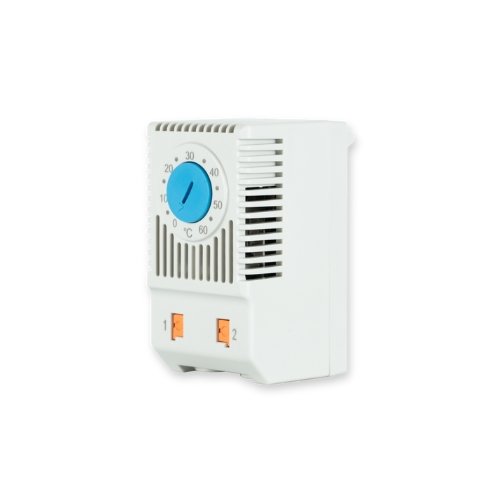
State whether the cabinet cooling fan runs continuously, is switched by a thermostat or requires a defined speed-control input. Ask for the motor’s applicable electrical data and the compatible controller. Do not infer a switching rating from the thermostat’s temperature range.
Include cabinet cooling fan access requirements for replacing filter media and the fan itself. A convenient service cover helps only if the installed cabinet has enough clearance to open it. Specify spare media by the correct part reference so future purchasing does not silently change the filtration arrangement.
Request product evidence without broad certification assumptions
Ask for the exact cabinet cooling fan model’s datasheet, installation instructions and applicable certification evidence. A certificate for a product family does not automatically describe every electrical variant or the protection rating of the completed assembly. The enclosure, openings, seals and installed components need to be considered together.
Record the supplier’s response beside each RFQ requirement: confirmed, exception or awaiting information. This creates a practical comparison sheet and prevents an incomplete quotation from appearing cheaper merely because an outlet filter, control device or required document is missing.
Turn cabinet cooling fan procurement into a repeatable handover
Before a repeat purchase, compare the approved part number, voltage suffix and accessory list with the new order. Keep cabinet cooling fan drawing revisions and approved substitutions visible. If the heat load or inlet conditions have changed, review sizing even when the mechanical fit is identical.
A complete cabinet cooling fan handover includes the calculation inputs, selected model, supplied accessories and commissioning record. For the next project, reuse that information as a template while checking the conditions again. This reduces clarification cycles without assuming that every cabinet has the same thermal duty.
Prepare your specification. Save your airflow calculation, select the relevant product family and send LEIPOLE the RFQ fields above for a model-specific response.